
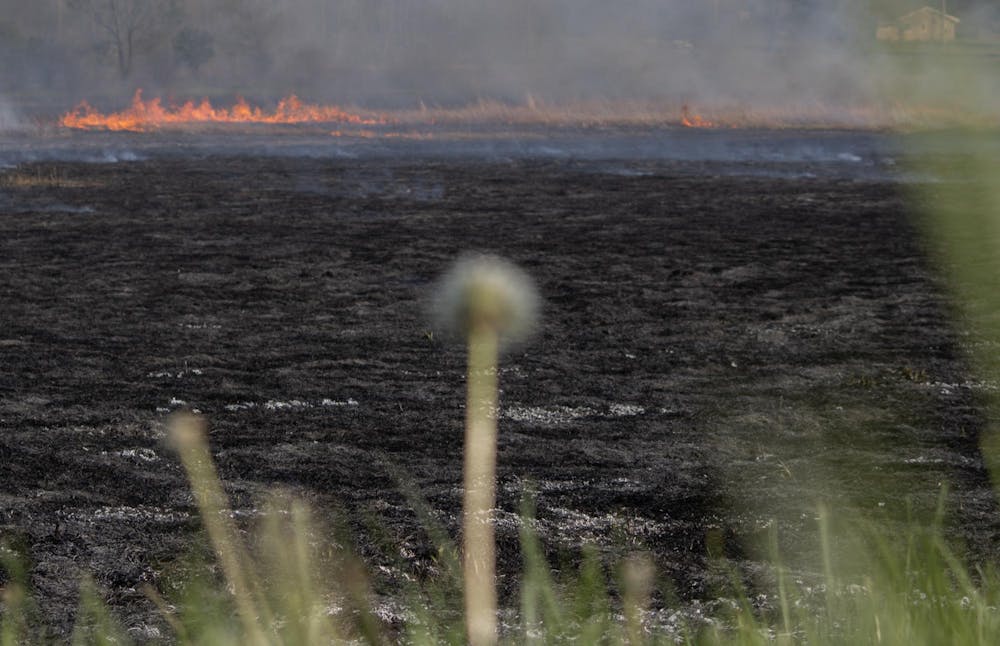
On Monday, April 20, smoke rose above Taylor’s campus.
Avis Industrial Corporation, the company owning the land east of campus, was conducting their annual prairie burn on their land. The burn started at 5 p.m. and finished shortly after.
Avis started the fire on the south side of the field, letting it spread northward. Flames reached around 50 feet into the air, leaving a black field in their wake.
There are several benefits to burning the prairie, Phil Grabowski, assistant professor of sustainable development, said. Most importantly, burning it allows the prairie to stay a prairie.
“If you don’t (burn),” Grabowski said, “especially in Indiana, in our climate and everything, woody species encroach, and eventually (it becomes) shrubby, shrubby land, and eventually a forest.”
The preservation of the prairie promotes biodiversity since prairie plants can’t grow in forests, he said. Those plants, in turn, provide a habitat for insects and birds
The man-made burn mimics natural processes, Grabowski said. In the Plain states, where prairies predominate, lightning strikes would start prairie fires and allow the prairies to regenerate themselves.
Intentional burning as a conservation technique has a long history in the U.S., Grabowski said.
“One thing we’re realizing as we study what America was like before the European people came was that the Native Americans were managing land, more than we thought,” he said. “We used think ‘Oh, it’s natural,’ but, actually, Native Americans would set fires to create habitats for animals to graze, which would create better hunting ground, or other plants might grow, which they would use for medicine or for building materials.” .
Avis took safety precautions in case anything went wrong. Jefferson Township volunteer firefighters were onsite in the event of an emergency.
“We’re here to make sure it doesn’t get out of control,” Bruce Howard, one of the firemen, said. “If it does, we stop it.”
The fire department wasn’t involved in the burn and would only step if an emergency happened, Howard said.
Nonetheless, while he was there, Howard intended to enjoy the view, he said.
“Once it starts burning, it creates its own intake; it pulls in more air,” Howard said. “It’s really neat.”
The unexpected sight startled some students, like Mary Keck, freshman human physiology major.
“I was horrified, because I thought there was a huge problem, but it’s clearly contained,” she said. “Honestly I was overcome with how beautiful it was.”
Jim Garringer, a photographer and former Taylor spokesperson who regularly attends the burning, agreed.
Each time he sees the burn, it sparks awe in him.
“This is the twentieth time I’ve seen it, easily, maybe more, but it’s just such a fascinating thing,” Garringer said. “ ... The idea that something that had grown up, matured, and then eventually died can be burned away, and the whole process started over again, is just fascinating to me.”
Garringer was drawn to the fire because it presented opportunities for photography. He was particularly interested in the way the fire interacted with the plants it consumed, which made for an interesting visual, he said.
The next burn will happen in the spring of 2027.


