
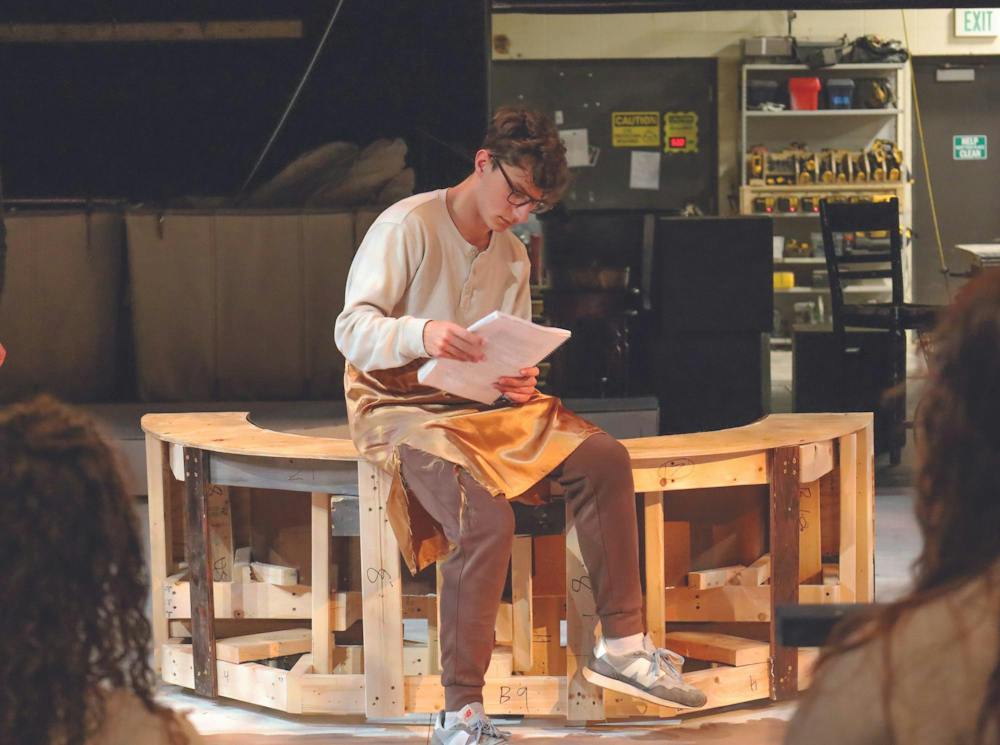
Any art medium can be reflective of God’s work as Creator, but the theatrical arts present storytelling in a manner unlike any other.
Historically, theater has been viewed as antithetical to Christian values on the grounds that early forms of theater were centered around pagan idol worship, debauchery and lewd themes. Taylor Theatre challenges the notion that theater has to remain a product of sin, reclaiming theater as a storytelling medium reflective of God.
Storytelling itself has already been accepted as valuable, and many mediums have already been embraced by the church for various storytelling purposes. Songwriting is used to teach Bible stories to children, poetry to reflect deeper on biblical concepts in abstract ways, painting to visually portray events of the Bible in more contemporary settings, and film as a means of deepening Christians’ emotional ties to character archetypes in the Bible.
Telling stories through theater offers something impossible with these other mediums: watching a physical person engaging in a story in real life in real time.
“(Theater) is the only storytelling performative art form where somebody is really doing what they’re doing in front of you, less than 30 feet away, maybe a couple hundred feet away. But they’re really up there, lending their body to a character, to their choices,” said Gavin Kastner, a senior musical theatre major. “It has a unique opportunity to show people tangibly a story in only a way that theater can, with real people right in front of you, and not with a barrier of a screen.”
Because of this, a connection is formed between actor and audience. Actors feed off of the input of the audience, Kastner said. That spurs actors toward in-the-moment decisions which subtly tailor the performance to the audience’s energy and engagement. Meanwhile, the audience becomes enthralled in the world the actors create, forging opportunities for learning and developing empathy, he said.
Theater, whether one is conscious of it or not, influences how the audience engages with the world and people around them, even after the curtain has been drawn, Kastner said. This is because theater performances always reveal something about what it means to be human and such revelations are not always overt.
Comedies may make the audience laugh, but there is always more being said through the story, a lesson to be learned, he said. Subconsciously, audience members internalize lessons learned vicariously through the characters portrayed onstage, he said, and understanding and empathy for the people and world God created are a direct result.
Furthermore, it is only because God, the Creator, made humans in His image that theater is a possible form of creating, Kastner said. It is because He loved that actors can love and thereby fuel their performances.
“Theater is art, and I think God is an artist,” said Josiah Hotmire, a sophomore theatre arts major. “I mean, look around: You see this beautiful place He’s created, these beautiful people. It’s just a wonderful thing, and that’s also what we’re doing. We’re creating art authentically and truthfully. We’re trying to portray a truth of this world, and I think that if you can do that — just truthfully tell a story — that’s a form of worship.”
Moreover, the stories being told belong to more than just the actors, Hotmire said. Theater stories belong to the playwright, the actors, the backstage crew and the audience alike.
The playwright observes the world and translates what they see into a script.
Actors portray stories and characters that are not explicitly their own with integrity and respect, Hotmire said. They study their characters and learn to embody them, Kastner said.
“What are we conveying about the world around us? How are we going to convey that authentically through specific and interesting choices that belong only to the character that I’m playing, and not myself as an actor? And how can we weave this narrative in the most beautiful, authentic way we can?” Kastner said.
The backstage crew delves into the world and extrapolates what makes the people and place tick, Kastner said. They work together to generate a space which feels real because it reflects reality.
Perhaps most importantly, the audience takes in the experience presented and figures out what to do with it. Theater can change the world through the hands of the audience, Kastner said. A performance is worth producing if even one audience member feels seen, heard or appreciated, Hotmire said.
“I really do love all art forms,” Hotmire said, “but I think that, in the theater, it’s especially vulnerable because we’re really putting it all out there, sometimes looking ridiculous. We’re really trying our hardest to — with our own bodies and voices and our selves — portray these stories that could be not our own.”


