
Twenty years ago, when I was a senior at Taylor, my roommate was the opinion editor for The Echo. He was an arts and culture guy, and he liked to jab at TU’s football team from time to time. One week, though, he devoted an entire column to their record. This was pretty low-hanging fruit at the time. They weren’t exactly known for winning, and everybody knew it. I remember a tense encounter between him and a few football players at the DC. I don’t remember exactly what was said, but I remember the feeling in the room.
I think about that story now because I am back at Taylor teaching art. The old divide between the arts and athletics is still funny to me. Artists tend to be associated with contemplation, solitude and sensitivity. Athletes are associated with physicality, competition and intense training. And yet, I’ve found myself borrowing something from the athletes, particularly their willingness to study what happened.
Athletes review the tape. They watch the missed opportunity, the bad decision, the movement that was slightly off. Then they go back to practice. The tape contains information.
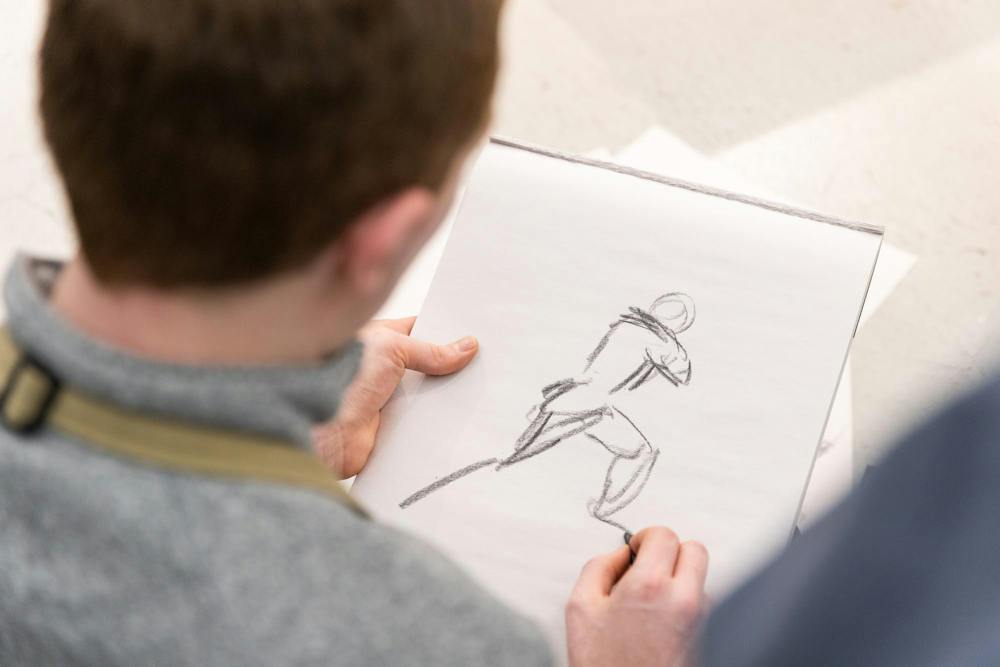
Artists have our own versions of this. A painter makes a study. A draftsman draws the same subject again. A printmaker pulls a proof.
I love that word, proof. You ink a plate, put the paper on the press, turn the handle and pull the print. When you lift the paper, you have learned something. Perhaps the line is too heavy. Perhaps the composition isn’t working. Maybe something unexpected happened that is actually better than what you intended. Either way, the print has given you information on where to go next.
We tend to encounter great works of art in their finished state. They hang on museum walls, reproduced in books and projected onto screens, and there is something deceptive about that. We see the painting, but we don’t see the weeks of uncertainty that preceded it.
Andrew Wyeth spoke about spending weeks circling an idea, drawing the same subject over and over again. Many of those drawings never became finished works. Some ended up on the studio floor. They were still part of the process. The looking accumulated. Ideas seeped into the work, sometimes surfacing much later in a painting that the public would eventually see.
The work you never show can still be part of the work people eventually see.
This is one of the things I want my students to understand. A bad drawing or a failed painting doesn’t have to become a referendum on whether they are artists. It can simply become evidence. There is a subtle difference between saying, “This isn’t working,” and saying, “I’m not good at this.” The first keeps you looking. The second tends to end the conversation.
It also takes some of the pressure off inspiration. We like the story of the artist who receives an idea, follows the muse into the studio and emerges with something fully formed. The reality is usually less romantic. The artist has to show up on the days when nothing seems to be happening. There are awkward paintings, bad drawings, wrong turns and long stretches of uncertainty. The work has to be pushed through some of those places before it has a chance to become itself.
That requires slowing down.
If you spend twenty minutes drawing a tree, you begin by drawing what you think a tree looks like. If you stay with it, eventually you start noticing this tree. The particular way its branches divide. The spaces between them. The temperature of the light. The broken edge of the leaves. Things become more complicated when we give them our attention.
There is a texture to ordinary life that is easy to miss when everything is experienced quickly and at a distance. Art gives us a reason to linger. A piece of paper has a surface. Charcoal has resistance. Paint dries. A press pushes back. The world keeps offering information, but we have to slow down enough to notice it.
Maybe that is one of the gifts of practice. Repetition doesn’t simply make us better at something. It can make us better at seeing. It can teach us to stay with something when our first impression isn’t enough, to accept that we don’t know yet, and to return tomorrow willing to look again.
The athlete reviews the tape. The printmaker pulls another proof. The painter steps back from the canvas and looks again. Each is trying to understand what happened without making the result mean too much about the self.
Then they return to work.
There will be another drawing tomorrow. Another proof. Another painting that might not work. There will be something to learn from it, if we are willing to stay long enough to see it.


