
Imago Dei, a Latin phrase meaning “the image of God,” is likely familiar to most Christians. Not only does it establish the intrinsic value of every person, but it also shows how our creativity mirrors the nature and work of God, the ultimate Creator.
Our ability to create is not a gift to be taken lightly. Yet, the rise of generative artificial intelligence is giving us new ways to ignore it.
Generative AI has grown increasingly accessible to the public in recent years. One of its most common uses is producing AI-generated images.
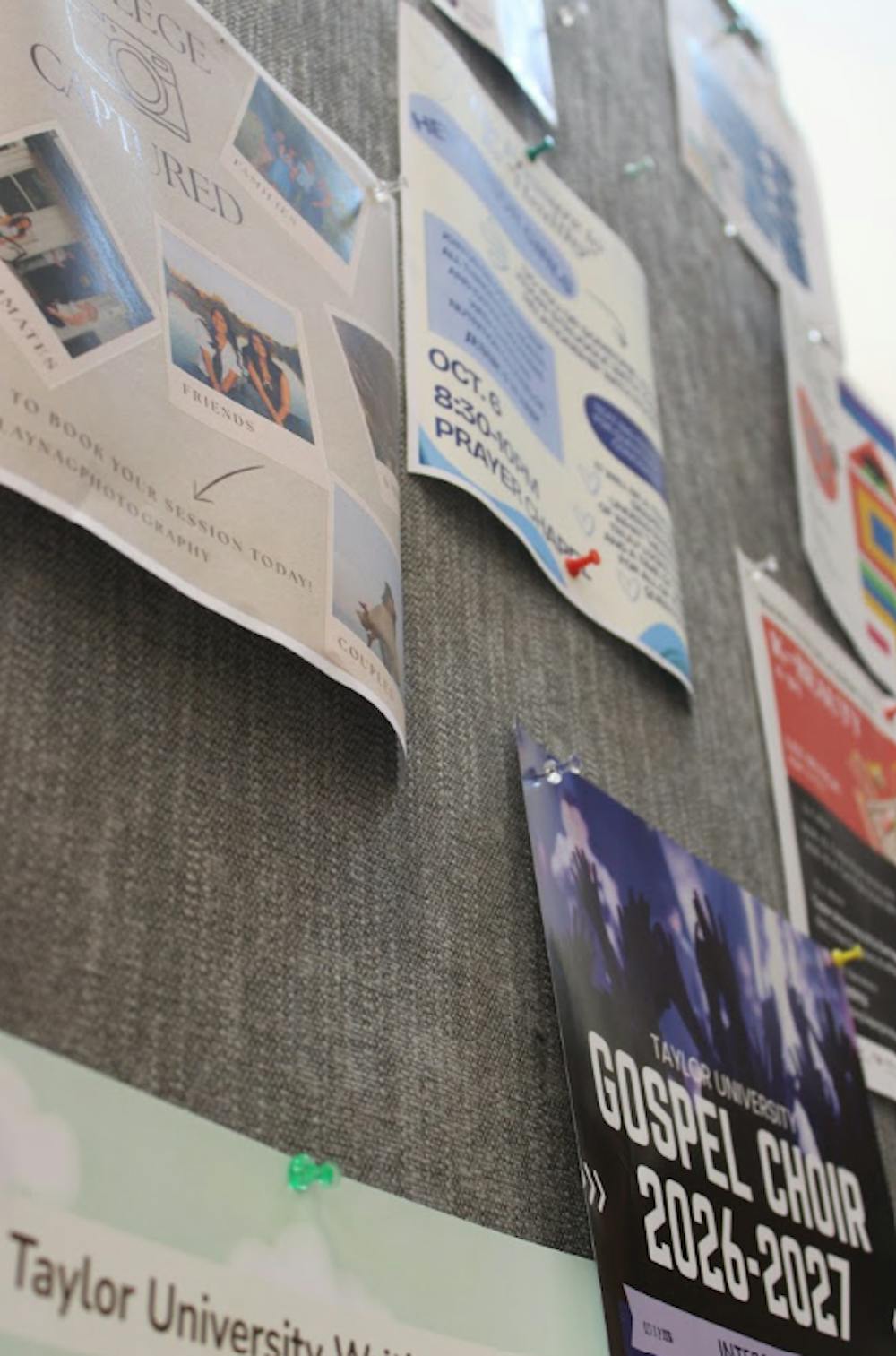
Such images have shown up in advertisements around Taylor’s campus this semester.
The livelihoods of artists, designers and creatives alike could be jeopardized if this technology is not taken seriously. Landin Brown, a professor of graphic design at Taylor, urges students to use caution before turning to AI to create art or advertisements.
“I would argue that a lot of the people that use generative AI are not using it in a way that is trying to intentionally hurt creative fields,” Brown said. “(Even so), I would urge a sense of consideration for those fields or processes that these models might be replacing.”
The Lord has blessed us with unique passions and gifts that we ought to use for His glory. Generative AI, if used improperly, could rob our brothers and sisters of opportunities to use theirs.
Art students are pursuing their degrees because they have been given creative inclinations meant to be shared with others. When organizations replace opportunities to apply hard-earned art skills with AI-generated content instead, it communicates a lack of respect for students’ passions.
Nevertheless, AI posters have been appearing around Taylor’s campus campus this semester.
“We have these abilities and want to use them to pour into the community we are surrounded by,” said Corbin Raines, a senior graphic art major. “I think creating these AI posters is a wasted opportunity to use humans for that.”
Saving time and money is a common reason people give for using AI to create images. But, Raines believes a sizable portion of graphic design students would take on poster design work for little to no cost.
The issue is that students are rarely given the chance in the first place as organizations increasingly turn to AI to handle their marketing.
An image or advertisement generated by AI is often lower quality than one made by an actual designer.
Human touch is what elevates students’ work above AI-generated work, said Emma Carlson, a junior graphic art major. She is also the president of Birrama Creative, a group of students who design posters and marketing content for campus organizations.
“A big part of what drives my work is my passion for the event at hand,” Carlson said. “AI is never going to have that emotion or soul behind it, which is why once you’ve seen one of those posters you’ve seen them all.”
Around campus, the advertisements made by people are distinctly different from the ones generated by AI.
Even when intentional thought and care are put into an event itself, AI-generated marketing can make it look cheap. A lack of effort in marketing suggests a lack of effort behind the event or organization it is promoting.
Carlson encourages organization leaders who are not familiar with graphic design to use resources like Canva to create even simple advertisements of their own.
“I think that’s so much better (than using AI) because there is still personal creation behind it,” Carlson said.
Ultimately, AI is not going anywhere, but that does not mean we need to compromise our convictions as Christians. It might not be an obvious connection at first, but our faith should shape how we use generative AI.
Generative AI cannot genuinely create in the same way people can. All it can do is reshape and regurgitate designs humans have already made. It cannot reflect the creative spark we carry simply by being God’s handiwork.
“We are made in the image of God,” Brown said. “AI is made in the image of us.”
Take pride in that truth. We are made in God’s image and can mirror His ability to create. We should use that spark to its fullest potential, not snuff it out by letting AI do the work for us.


