
Efficient, public, leadership developer
Arms crossed, D. Michael Lindsay leaned with his back to the window, facing the cherry wooden conference table where his presidential fellow sat at attention.
It was “5:00 p.m. email time, ” as written in his daily schedule. He had been clearing out his inbox all day, and now it was time for verbal dictation.
Lindsay arrived at Taylor University in 2021 after 10 years as president at Gordon College in Wenham, Massachusetts.
His inauguration as president of Taylor came at a crucial time in the world of higher education. According to a report by Huron Consulting Group, “... more than 130 private nonprofit colleges and universities have announced or executed closures and mergers with other institutions” between 2020 and 2025. Another 834 are threatened with moderate to fatal levels of financial deficit.
Taylor University has the opposite challenge.
Taylor is a liberal arts Christian university of 2,300 undergraduate students nestled in the cornfields of Upland, Indiana. It’s the oldest non-denominational university affiliated with the Council for Christian Colleges and Universities (CCCU), yet has not remained stagnant.
Construction efforts on campus and into the surrounding town serve as an illustration for the school’s dramatic success in the past five years—one that has pushed them to record levels of giving, expansion and impact.
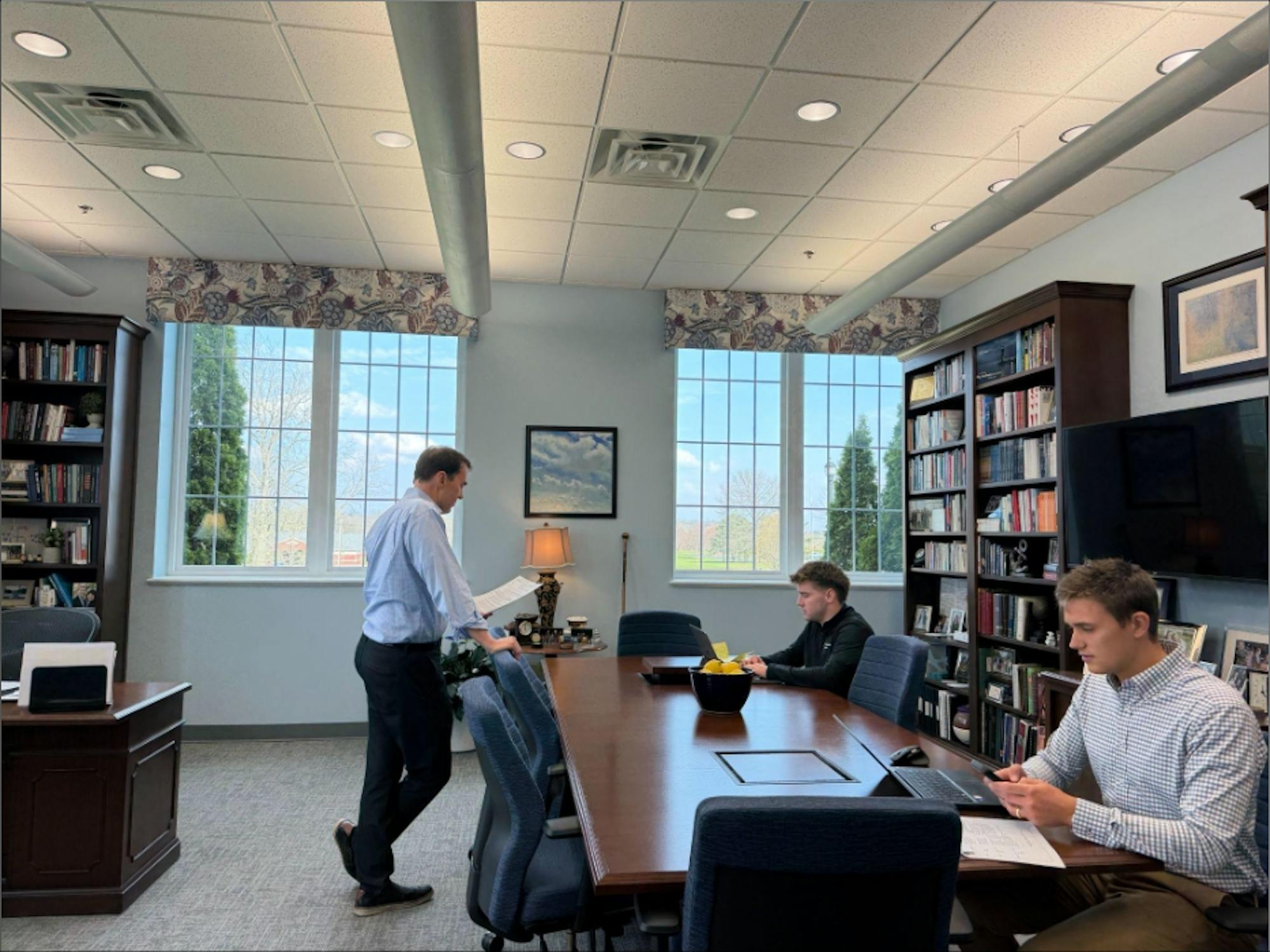
Clad in a purple sweater and matching checked dress shirt with gray slacks, Lindsay strode around his office, the evening light streaming in. Sometimes he would stare out the window, sometimes he’d pause, hands in pockets. He spelled out the words he thought might trip up his presidential fellow, who would only look up once he’d finished his furious typing stints.
His hands waved in the air in a dome-like shape as he tried to find the word in his reply to an email discussing architectural design.
His fellow, Dray Caldwell, offered a suggestion.
“Arch?”
Lindsay’s chief of staff, Chris Jones, and deputy chief of staff, Noah Ross, appeared in the doorway. They were wondering about details for the next day’s schedule.
“This is the time we get all our questions in for him, ” Jones said.
Lindsay didn’t miss a beat. He was back to the email from before—and then he was asking his staff whether they had planned to play music in the great room of his home, where he and his wife, Rebecca, would host three dinners later that evening.
“Efficiency really, really matters, ” Lindsay said. “If I can shave off 30 minutes of administrative time every day and do that all year, that represents about a week and a half of time that I wouldn't otherwise have. I'm always trying to figure out, how do I maximize every moment?”
“I'm also probably more attentive to it, because I'm trying to figure out, how can I have a demanding job and a nurturing family life? And there are very, very few presidents who have successfully served in the presidency for as long as I have, who've also had a nurturing family life.”
Ross asked Lindsay if he would like speaking notes for the chapel service he would be a part of the next morning.
He declined the offer, opting instead for an order of service.
Lindsay often travels to speak at high schools, churches and other higher education institutions.
“I have a good memory. It's not photographic. I work at it. Most of the major talks that I give, I write a manuscript, because I think that the prose matters. And when you're a university leader, you need to be able to elevate the level of language … and that requires practice. So after I write a manuscript, I then record that message and I listen to it, five, 10, 15, sometimes 20 times, while I'm working out, while I'm walking, when I'm driving somewhere, to help me to take it from my head and put it into my heart, and that's the only way I can do it. I've given about 100 unique talks this academic year, which is the most I've ever done.
Lindsay’s commitment to purposeful and efficient leadership has propelled the university to heights of enrollment and financial success alike.
Taylor’s 180th academic year and the largest enrollment year converged in 2025, with 661 freshmen and 42 transfers making the move to Upland—these numbers represent a 66% increase since fall 2021.
Preceding this season of growth, the largest freshman class of the past three decades was 531 students in 2018. Simultaneously, the university is nearing the end of the five-year strategic plan entitled Taylor Thrives, which prioritizes a well-positioned campus, nurtured community and enacted mission, backed by a $500 million campaign that represents one of the largest fundraising initiatives ever for a Christian college. More than $425 million toward the goal has already been identified.
In January 2024, Taylor received a $30 million grant from the Lilly Endowment for the development and beautification of Upland, a gift that the university has put towards their $100 million town improvement plan, the Main Street Mile Initiative.
For a school like Taylor operating in the current Christian higher education landscape of enrollment decline and financial instability, administrative harmony is not just a luxury, but a necessity.
Taylor’s senior leadership team is made up of initiators, introverts, risk takers and fun-seekers.
Lindsay and his colleagues’ varying approaches to their roles are not just arbitrary but a main reason why the school has seen such success.
A self-proclaimed “connector, ” Lindsay considers his inner circle to constitute anywhere from 30 to 50 people, and narrowing in further than that, 12 close friends.
“The presidency is a tough role to be in if you're an especially private person, because people are curious, and the only way you work is if you let them in to know who you are. So I have to figure out how to do that relatively publicly.”
He makes an effort to touch base with one member of Taylor’s Board of Trustees in some way every day.
Though people skills come easily to him, institutional leadership development was something he has had to develop over time. For this, Lindsay credits his addition of the chief of staff role as something that he has intentionally positioned to complement his unique wiring.
The other members of the senior leadership team complement each other in a similar way.
Nostalgic, introverted, disciple maker
Across the north side of campus from Lindsay’s office in Ayres Alumni Memorial Hall is the LaRita Boren Campus Center, a building students have affectionately nicknamed.
They call it “the Stu,” short for student center.
Skip Trudeau, vice president for Student Development, prefers the original title.
Trudeau is shorter in stature than Lindsay and often can be seen dressed in suit and tie.
Sometimes he completes the outfit with black sunglasses while walking around campus.
Also in contrast to Lindsay, Trudeau has been at Taylor for 27 years—long enough to have lasting memories of those for whom its buildings are named.
Leland and LaRita Boren were highly impactful in both their generosity to Taylor and personal friendship with his family. For Trudeau, they represent the thing that fuels him most in his work: people.
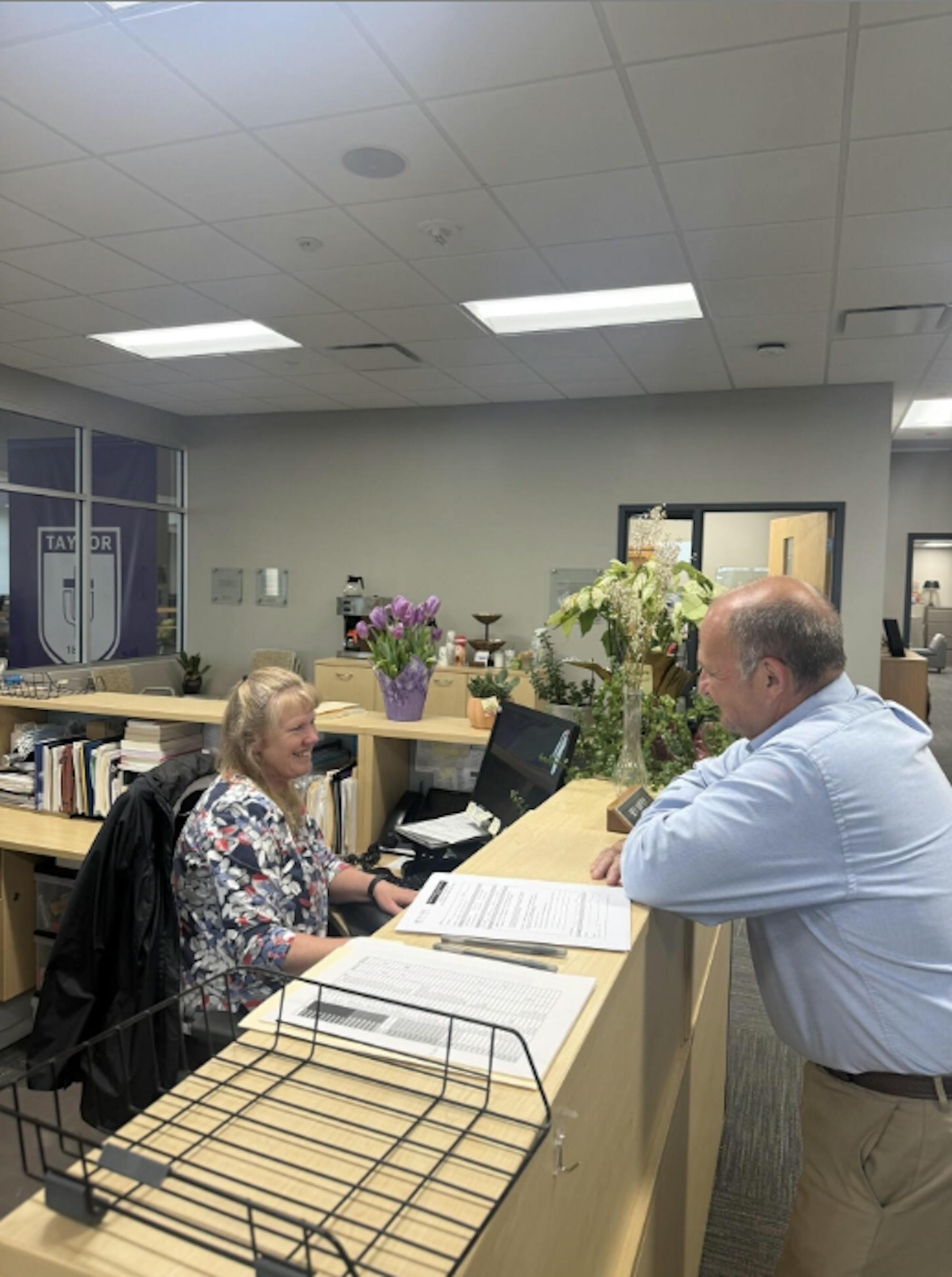
Cluttered across Trudeau’s bookshelf are mugs, figurines, and mementos stamped with Taylor logos from decades past.
“Did I explain my art?”
Every art piece hanging on Trudeau’s walls is from a student who has served in residence life at Taylor—all, except one that comes from the Boren collection.
Looking at a little wooden cross on the wall across the room from him, he told the story of the student who gave it to him at the time of their baptism.
“All of these have that kind of experience, and it's been a really rich, life-giving thing, to be a part of Taylor students’ (lives).”
The work of each member of Taylor’s senior leadership team heavily overlaps with one another—and yet they each approach their work with a different style.
Trudeau is an introvert.
When he goes home, he often sits down with a book.
“Everybody assumes that, either by my role or by the way they experience me when I'm in the office, that I'm an extrovert. I'm not an extrovert. When I go home, I want a book and downtime.”
Trudeau’s introverted orientation proves that people development doesn’t have to look like extroversion.
“I think I'm kind of a high-mileage disciple guy. And so whether it's in the academic world or intramural field or discipline situations, I look at what I'm doing as discipleship. You got to be a discipler.”
Trudeau joins Lindsay in the belief that discipleship begins at home.
Growing up on a cattle ranch in Colorado, Trudeau’s family was centered around hard work and rising early in the morning—a habit he has carried into the higher education world.
He considers his wife, Jennifer, to be one of his biggest supporters and co-laborers. Together, they raised five children on Taylor’s campus.
In a meeting with his residence life staff, it was Trudeau’s turn to share his spring break plans.
“I’m gonna go be G-Pa. It’s my best job.”
Humorous, steady, involved dad
Jewerl Maxwell, provost at Taylor, also assumes the role as father to four young kids.
“My kids think that I only go to meetings and do email. That’s basically what they think my job is.”
With a wife in the medical field, Maxwell says that every time he is at home, he steps into full-on dad mode.
This particular morning, that included breakfast duty. He still arrived at his 8 a.m. university town hall right on time. He was participating in a presentation on artificial intelligence, and it was time to present before his faculty audience.
He jumped up on stage, commanding attention with his height and poise. He was wearing a button-down and Vineyard Vines vest.
“Had I used AI, my PowerPoint slides would have been better.”
Everyone laughed.
Maxwell came to Taylor from Gordon College around the same time as Lindsay. There, he served as vice president for academic initiatives under Lindsay, Gordon’s eighth president.
He’s gleaned much from Lindsay’s leadership over the years, specifically in the areas of interpersonal development, the practice of spiritual disciplines and the importance of strategy in future-planning.
“I think that he truly cares about developing people, putting them in a position where they can thrive and continue to grow in their own career,” Maxwell said.
Deb Carpenter is Maxwell’s executive assistant.
“I’ve been working with him for four years and I’ve never once seen him rattled,” she said. That is exactly how Maxwell described the type of personality that is best for someone in his position.
“The way I describe it would be more steady—a personality that probably doesn’t fluctuate too much one way or the other … more of a steady, even-keeled type approach. Not rattled easily.”
What Maxwell loves about his job is the interconnectedness of the role. Outside of the president’s role, he believes his position is one with the most breadth.
As provost, Maxwell oversees the faculty and implements strategies related to curriculum and classroom programming. This role involves high contact with individuals all across campus—something that Maxwell does not shy away from.
Following Lindsay’s example, he meets biweekly with those who report to him.
He also makes sure that every colleague in his sphere who has a birthday that month receives a cupcake, delivered by his presidential fellow.
“I think life should be fun,” Maxwell said.
As a rule of thumb, he always tries to incorporate humor into his presentations as it helps lighten the mood and engage those around him.
His workspace is not complete without a sparkling water drink sitting close by. His brand of choice is Waterloo, and he has a specific regimen that he follows—certain flavors for the morning, midday and afternoon.
With four children, Maxwell acknowledges that the way he operates within his role may look different than if someone in a different stage of life were in his position.
For example, he and his family frequently attend Taylor’s athletic events, where his children enjoy running up and down the sidelines.
From 5 p.m. to when his children are asleep, he doesn’t look at email.
“I think there might be other people in my role who would not shut down, necessarily. While I may work later in the evening than what most people do, it’s also that I’ve had a gap in time, and so I’ve had that ability to rest or get away from work a little bit more than might be the norm.”
Feeler, detail-oriented, risk taker
Holly Whitby says she and Gregory Dyson, vice president for spiritual life and intercultural leadership, are some of the only vice presidents on the team who are what she refers to as “feelers.”
“Regularly Greg and I will say, ‘I feel that this is going to be the experience of whatever constituency the decision is going to affect.’ I typically go first to ‘How are people going to feel,’ or ‘How is this going to come across to them.’ But I also am a very firm believer in data and facts and all of that. I just tend to marry those two.”
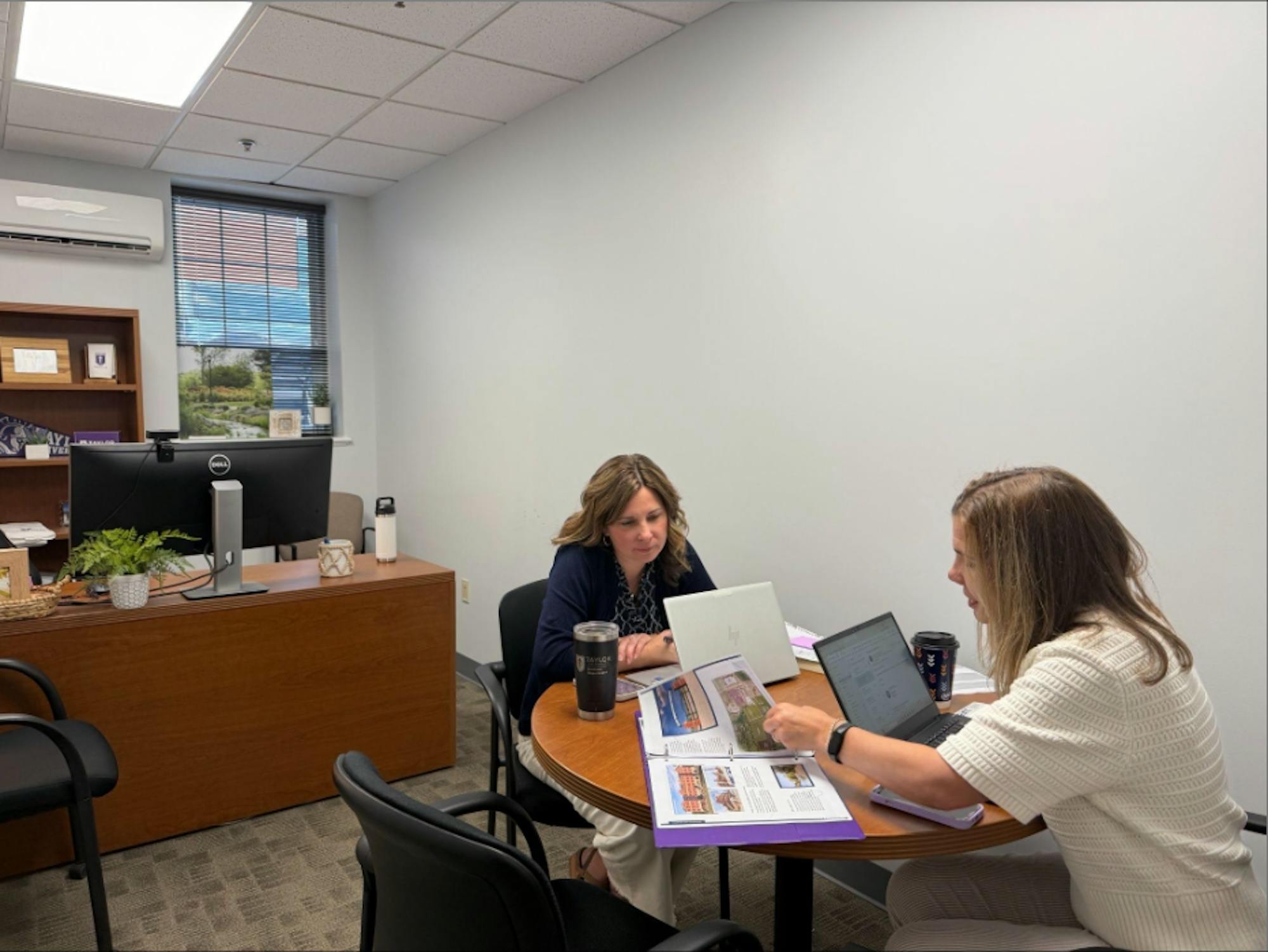
Whitby, vice president for Enrollment and Marketing, came to Taylor in 2021 from her alma mater, Trevecca Nazarene University, where she served in several different roles in the realms of marketing, enrollment, and admissions.
Today she was starting off the day in a morning meeting with the marketing team, bright-eyed in her zebra-print blouse and khaki blazer.
Whitby sat back at the round white table, listening to each of her colleagues’ updates and taking notes on her paper agenda or sending messages on her phone—complete with a purple phone case.
She didn’t interject often—if she did, it was to provide context or specific details for her team. The group was discussing current and upcoming marketing initiatives, including the billboards that were currently posted around the area.
Whitby said she had driven past one of their billboards the night prior, as she was dropping her husband at the airport.
Her oldest son graduated from Taylor in 2025, and her younger son is a current junior.
Her eyes sparkled as she reflected on their experience at Taylor.
“Most parents have to say goodbye to their kids after senior year and see them on breaks, and we’ve just been able to watch our kids thrive at Taylor. That’s an additional four years of blessing and joy.”
Whitby describes herself as a risk-taker. She says her role is very competitive.
Each Monday, Whitby and her enrollment team designate an hour and a half for strategic marketing conversations.
One such meeting found the group discussing the projected numbers for next year’s incoming freshman class. As each incoming class has exceeded the last for the past five years, Whitby and her team are relying on their intuition and experience to decide how many students to admit each year.
“I’m normally a ‘Let’s go! Let’s move forward’ type of person,” she told the group.
In the particular instance they were discussing, however, she felt it was important to slow down. This week, Taylor would host one of their 24@Taylor events designed for prospective students to experience an overnight visit on campus.
Whitby suggested that the dining service switch to dealing out paper products instead of the traditional dishware due to the overwhelming number of guests expected. They had run out before, and she didn’t want the guests to have to go searching for a fork.
As is the case with her senior level colleagues, Whitby is careful to keep from weighing in with her opinion before letting others have a chance to share theirs.
“It's not my way or the highway, but I'd like to at least express my opinion, and once my opinion is heard, if we don't go that direction, it's fine with me, but it's just important to be heard, and I think it's good for everybody around the table in the decision process to be heard.”
“I’m a big believer that if people are really competent and capable, you just let them do their jobs. We’re winning because we’re a team.”
What makes a winning team?
This sentiment is not one that is isolated to Whitby’s perception of her role.
Neither Whitby nor Lindsay, Maxwell or Trudeau are afraid of conflict.
This posture paves the way for healthy disagreement between members of the senior leadership team.
“Whitby, Maxwell, and Trudeau each bring a high level of competence in their respective areas, and they have earned the respect of their peers over time,” Lindsay said. “They do not step on each other’s toes; there is a clear sense of ownership, along with a willingness to support one another when needed. That kind of clarity and humility is not always easy to find, but it makes a real difference in how they work together.”
It is unity behind a shared purpose that fuels effective teamwork.
“I think any human endeavor is going to have its share of conflicts,” Trudeau said. “And this is probably more true of Taylor than other places I've been: I think there's a shared sense of mission … It makes it easier to work through when you are in conflict.”
Lindsay believes the team’s deep sense of trust in each other has contributed to lasting success.
“They communicate well, they assume the best, and they are aligned in their desire to serve the University well. We have been intentional about building a team culture marked by mutual respect and shared purpose, and that has helped them complement each other in ways that are both effective and durable.”
Professionals turned people
Having such a forward-facing leadership role is no small thing.
It is this sense of rootedness that each member of Taylor’s top leadership team must draw from in order to attend to the demands of their jobs—and they do.
At the end of his workday, Lindsay doesn’t travel far to return home.
He and Rebecca live in a residence on campus called the Muselman House with their three daughters: Elizabeth, Caroline and Emily. Twins Caroline and Emily are sophomores in high school. Lindsay’s hope is that he is building a school that he would be proud for his daughters to attend.
“Being a dad relativizes the importance of my role,” he said. “It reminds me, truthfully, the impact I have at Taylor University will pale in comparison to the possible impact I could have in influencing my daughters. No victory at work is worth losing at home.“

