
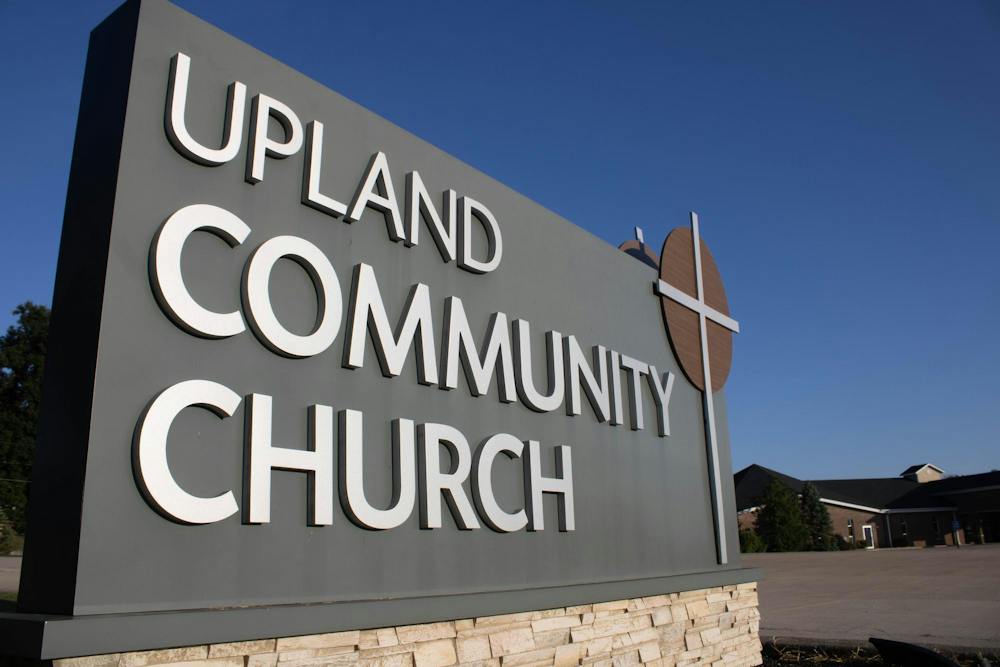
Chapel services have been woven into Taylor’s student experience since the university’s earliest days. For many students, they’ve become one of the most meaningful threads of Taylor culture.
Chapel does not, however, replace the need to attend church on Sundays, Craig Long, assistant professor of biblical studies, said.
Many local churches in Grant County have welcomed Taylor students for decades, and continue to invite new students into their community each year.
Long strongly encourages students to invest themselves in these local churches.
“Being in a local church, even though it shares common elements of chapel like worship and proclamation of Scripture, it pushes us to be part of something multigenerational,” Long said.
Local churches also offer diverse worship styles, Long said.
Zach Hoon, a sophomore finance major and Discipleship Assistant in Samuel Morris Hall, is also passionate about Taylor students joining local churches.
“A church gives you resources to people that could be mentors for you while you’re here at Taylor,” he said. “I think it’s important to experience something outside of the Taylor bubble for your spiritual growth.”
There are several important operational aspects to consider when considering a church, Hoon said. Above all else, their teaching must be rooted in Scripture.
Searching for a church to call home while at Taylor pushes students to ask challenging questions about their own beliefs, he said.
“College is a unique time for you to figure out your own beliefs,” Hoon said. “When we’re looking at churches, we see what they do, see if it aligns with the Bible and see if it aligns with what we individually believe.”
Whether or not a church has a strong and active community should be another deciding factor, Hoon said.
Students of all grade levels should not only visit churches, but attend church events and build relationships with other believers at those events, Long said.
Providing for the greater Grant County community through church-organized service projects is an easy and practical way to serve with the church body, Long said.
“Look for a place where, when you’re there, you can say ‘I can see myself serving here,’” he said.
The theological triage of orthodoxy (right belief), orthopraxy (right action) and orthopathy (right feeling) can also be beneficial to consider before committing to a church.
Students should ponder and pray over to what extent they are comfortable attending a church where they do not necessarily agree with everything they do, Long said. They should also pay attention to how the church handles sensitive topics.
“We’re all wired different emotionally,” Long said. “We need to ask how the church engages emotion. Is it engaging it as a part of who you are and as something that ought to be engaged, or is it engaging in a manipulative manner?”
Additionally, Long encourages students to investigate how the church lives out their faith. He suggests observing how they care for others, live like Jesus and use their money responsibly to further God’s kingdom.
Being involved with a local church benefits more than just the student attending. Churches in Grant County have valued the presence of college students in their communities.
Tyler Shirley, co-pastor at Exit Church, loves seeing college students get involved with the church.
“It’s hard to have time, energy and money altogether,” Shirley said. “In a student’s life there is usually not a lot of money, but a lot of time and energy. It might not feel that way, but that’s generally true. I love to see college students using their time and energy specifically for furthering God’s kingdom.”
College students often give back to Exit Church through community service projects, being part of a worship team, assisting with greetings and more, Shirley said.
Personally, he regrets not committing to a church during his freshman year of college.
“By sophomore year I realized that every church has its problems and I just need to pick one,” Shirley said. “It’s such a joy to see college students who commit quickly and stay super involved wherever they’re at for the time they’re there.”
Shirley urges students to pray over the church they plan to attend, but not to postpone the decision.
Local church attendance and getting involved in the community can significantly further spiritual growth, he said.
“I think there can be a mindset that real life will only start when you get a job and finish college,” Shirley said. “I would say it’s not very helpful to think that way, because with whatever you do in college, you are functionally building habits and pathways that you may keep for the rest of your life. You’re an adult, and the Lord is using this season to prepare you. So how do you want to live it?”


