
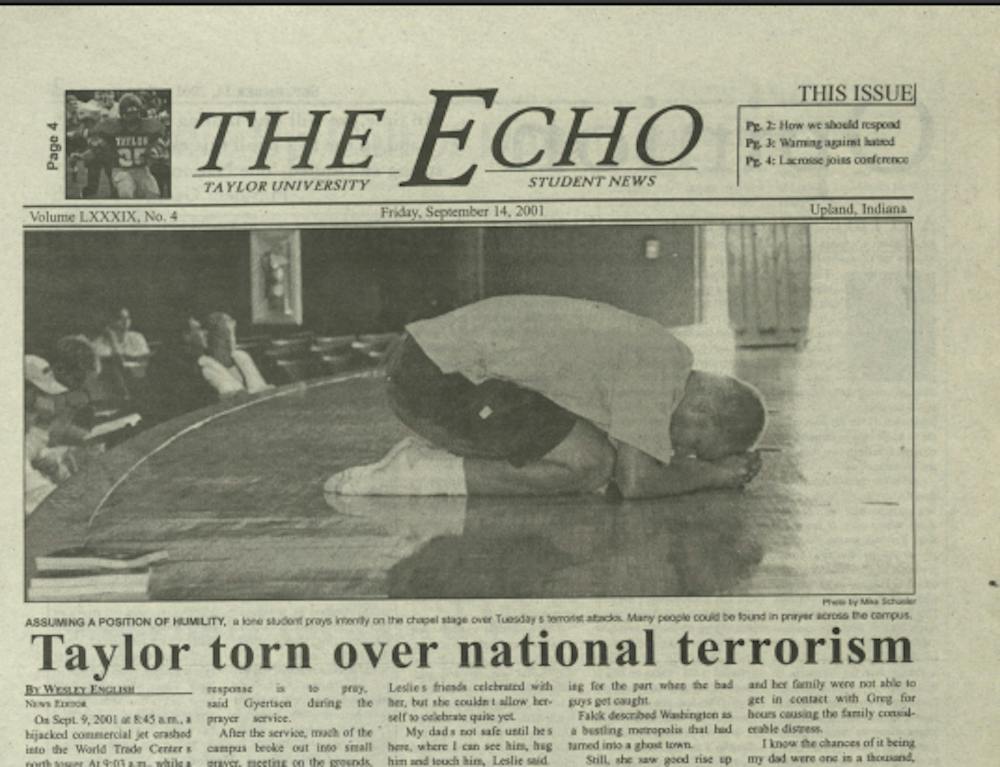
This month, the nation commemorated those who died in the deadliest terrorist attack in American history 25 years ago. On Sept. 11, 2001, Al-Qaida militants flew hijacked planes into the World Trade Center in New York and the Pentagon in Washington, D.C. 2,977 people died, with many more injured, according to the 9/11 Memorial.
Other outlets and commentators have testified more eloquently to the shock and grief Americans felt in the aftermath of 9/11; The Echo cannot hope to match that. What we can do is reflect, 25 years after the attack, on our own coverage of the events.
Wesley English was the editor of The Echo’s news section in 2001. He remembers covering the attacks on the morning of Sept. 11 — a complicated task when nobody knew what was happening. Campus was full of strong emotions including grief and fear as people learned about the loss of life, he said.
“The biggest memory, the biggest event that day, was when we all gathered in the chapel for a prayer service of sorts,” English said. “I remember professor Smith stood up and basically challenged the campus to break out of that (church) mold and say that it’s okay to admit that we’re afraid and that we’re in grief over this, that we’re struggling. After that, it became, at least in my memory, less of a church service and more of a raw prayer service: one where we were all processing it in groups ... It was very, very raw.”
As time passed, however, those initial emotions began to change, he said. In the immediate aftermath of the attacks, on Sept. 11 and 12, Taylor was scared and in shock; by Sept. 13 and 14, when The Echo was published, that pain had gained an edge of anger.
The editorials we published uniformly called for war. Stephen Hoffman, professor of political science, who himself served as a consular officer in Baghdad, Iraq, argued for a military response in defense of the American order, quoting Saint Augustine, the father of just war theory. Ted Dorman, professor of the Bible, linked Al-Qaida to Hitler and the perpetrators of the Holocaust, and he called for Americans to once again use “disproportionate military action” as we did in World War II. J. Daryl Charles, professor of religion and philosophy, called for Taylor students to recognize that the barbarism of the attacks meant Christ’s command to love our enemies was momentarily irrelevant.
In making those claims, Taylor only expressed the same feelings the rest of the nation was experiencing. The emotional impact of the attacks was heightened coming after a decade of peace, Philip Byers, Halbrook chair of civic engagement, said.
“It’s probably hard for anyone who didn’t live through it to understand what the ‘90s were like,” he said, emphasizing American confidence in its own power after the end of the Cold War. “The ‘90s were a time of feeling just kind of broad-based optimism, you know. And so when the attacks happen, the towers come down, I think that shook people: people who had felt impregnable and had not been alert (to the complexities of geopolitics).”
In the wake of that shock, support for military action was high, Byers said. He pointed to the high degree of congressional support for the subsequent invasions, the formation of security agencies such as TSA, and ultimately the passage of the Patriot Act. All those government actions would have been unimaginable without the shock and terror of 9/11.
25 years later, English has regrets over the content of those editorials, believing it imperfectly represented the views of the community. While most of the student body did support war, there were voices urging restraint that didn’t get published, especially as time went on.
“By that time (2002), even my pretty conservative dad was a little bit wary of the invasion, and I remember a similar thing among students — maybe more so among faculty — of there being questioning of the war,” English said. “There was much more debate about it than you would take away from reading the editorial section ... Not saying it wasn’t predominantly in support, but there was much more discussion and debate about it.”
In particular, he said, some of the older professors were more wary of the war-fever, expressing caution over what the rush of anger would lead to, both politically and spiritually. Of those writing editorials, however, only Hoffman, the only one with any expertise in Middle Eastern foreign policy, offered any sort of cautionary advice.
In time, the War on Terror would touch English’s generation too.
“I had a couple of friends who ended up fighting in that war,” he said. “One of them lost his leg. He was riding in a Humvee and he got hit with a rocket-propelled grenade. Unfortunately, it was a dud, but it went through his leg so he passed out and wakes up in Germany. So he never walked on his own feet again.”
Each edition of The Echo bears our motto on the masthead, below the title: “You are the voice. We are the Echo.” In publishing those words every week, we express our commitment to Taylor’s community and establish our place in it. We are part of Taylor and write with that in mind.
25 years later, the U.S. Army has pulled out of Iraq and Afghanistan; both parties now seem happy to ignore those conflicts, even as our current political landscape has been deeply shaped by them. The concerns our editorials once had now seem “historical” and radically different from those we hold today.
What does that say about us? Are we propagandists, repeating professorial opinions? Are we gullible, repeating what the nation “knows” to be true? Rather, we represent Taylor’s views — both good and bad, capturing them in real time — now as we did in 2001.
So inextricably bound, therefore, the views of The Echo cannot be separated from the rest of Taylor’s history. When we look back on our coverage and response to the 9/11 attacks, that calls us to reflect not only on the actions of our own paper, but that of the country, including the lasting effects of that anger and willingness to wage war.
English certainly has.
“If you were to ask a lot of those people, I don’t know about those professors particularly or those students who wrote those editorials, but if you were to ask many people, or if I were to ask myself how I felt at the time, how I wanted to our country to move forward, I have a very, very different perspective today,” he said.


