
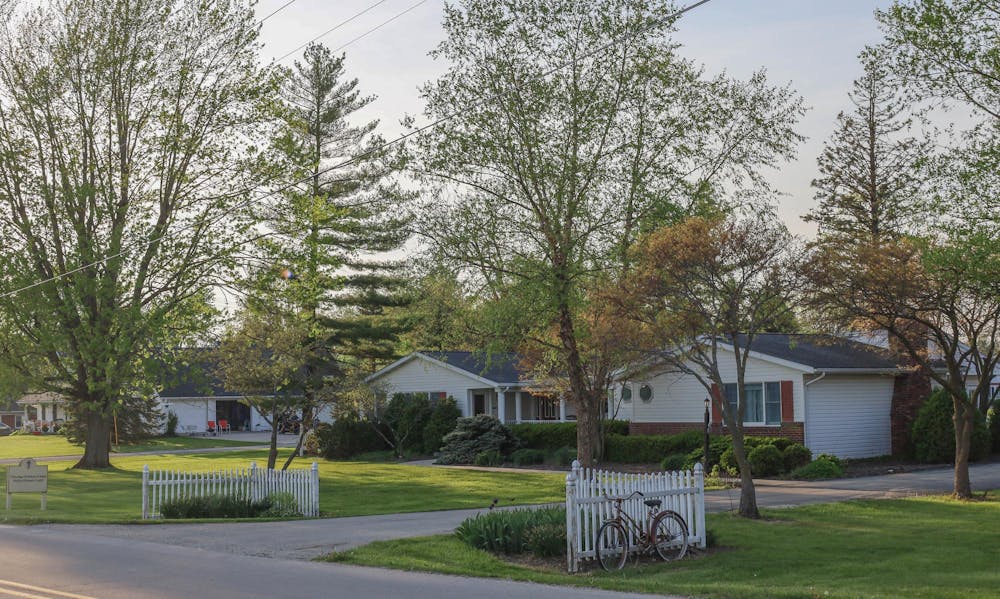
The Honors Program will vacate the Honors Lodge by the end of the year. The dedicated space for Honors students will be replaced by a new facility in Gentile Hall.
Honors students were informed about the change April 7, when Scott Moeschberger, dean of Global Engagement and executive director of Honors, announced the move to Gentile via email.
The Lodge, a small building on the corner of Reade Blvd. and University Ave. will host the Construction Services office next year, Chris Jones, vice president, chief of staff, and chief information officer, said.
After that year, Taylor administration will decide whether or not to demolish it, Jones said. Despite conversations about the subject, no final decision has been made.
The new space in Gentile will be shared with the Spencer Center for Global Engagement, currently located on the second floor of the Larita Boren Campus Center, Moeschberger said. The space will be completely separate from the rest of Gentile.
In addition to hosting the offices of Moeschberger and Kris Johnson, director of honors programming, the new Honors location will include a central area for Honors students to hang out, he said. Most of the old Lodge furniture will be taken to Gentile, adding continuity between the old and new spaces.
In addition, the Gentile Honors space will be able to support Honors classes and talks in ways the old Lodge couldn’t through its multi-purpose conference room, Moeschberger said.
“We have the space to seat 24 students pretty comfortably in a conference room kind of environment,” he said. “We can use it for a talk, we can use it for a classroom space, we can use it as a conference room.”
Previously, some Honors classes, referred to as colloquiums, as well as lectures, occurred across campus. Now, they’ll be held in the new Honors space.
As a result, the Honors space will feel full of life, Moeschberger said.
“We’ve got student interns, we’ve got hangouts,” he said. “It’s going to feel way more active, and be kind of the hub on campus, than what we’ve had in the past. I get really excited for that.”
Other Honors events, such as the all-important Pie Night, where Honors students bake pies and invite Taylor to enjoy them, may be moved to Randall, where it can be observed more sustainably, Moeschberger said.
Among the reasons for the move was a decline in use of the Lodge, Moeschberger said. In the past, it was used more frequently: the Lodge had hosted graduate assistants in the Lodge’s living space, which drew students to it.
Philip Byers, Halbrook chair of civic engagement, was the first grad student to live in the building.
“In late spring 2009, right as the semester was wrapping up, a couple – I believe their last name was the Kinsers – who had lived in that house for a long time were ready to move out of it,” Byers said. “And I don’t know who contacted whom, if the university reached out to them or they said, ‘We know this is prime real estate, are you interested?’”
The offer came as Taylor was changing its Honors program, reshaping it into a distinct academic experience. At this time, Taylor invited Scott and Jennifer Moeschberger to run the program and planned the first Honors trip abroad.
Byers, as grad assistant, was active in that process, researching the Honors programs of other universities and suggesting changes to Taylor’s.
“We thought if it’s (the Honors Program) going to succeed at Taylor, it needs to be experiential,” he said. “It needs to be immersive. It needs that word we always use around here – community.”
The Lodge, then, answered that need perfectly, becoming a place where students would hangout together.
While Honors students were still getting used to the idea of the Lodge during Byers’ tenure, it grew in popularity after he left, he said.
“I do think that it became a place where the GA’s (graduate assistants) would hold their version of office hours, open hours, or whatever, and just be in the Lodge,” Byers said. “And you know how Taylor students are – they like a chance to connect with anyone, certainly with other students, but also with professors and people who work here.”
Despite the frequent use of the past, however, the Lodge has seen lessened use in recent years.
“There’s a recognition that post-COVID, there’s not a grad student anymore. We don’t have speakers there anymore,” Moeschberger said. “We’ve tried to kind of get it re-energized, but we haven’t been able to get the numbers as high as they were before. And so I think there’s our recognition that there’s just a changing need of honors with what our students are interested in.”
That assessment was echoed by Keira Martin, a senior history major in Honors.
The Lodge used to be used more often, even as recently as her freshman year, Martin said. She thought it could have been utilized more often, even back then.
Nonetheless, she felt a degree of sadness when learning it would be vacated.
“I feel really nostalgic about the Honors Lodge,” she said. “Since I’ve gotten here, there’s been so many fun events. I mean, like, I love Pie Night so much. I’ve been able to meet with my precept group there. And, I’ve loved knowing that I could go there.”
Martin experienced guilt over the end of the Lodge, recognizing that she didn’t use the Lodge as much as she could have, she said.
Even as Honors students and faculty process their sadness and regret, many anticipate the new space.
“I will look fondly back at a place I lived for a while and have good memories (about),” Byers said. “I can remember some of the scholars we hosted while I was there, and I have warm feelings about the place, but I’m also excited about what’s next.”


