
NearSpace Education celebrated the results of Dream Big phase one, and announced Dream Big phase two at their celebration ceremony on April 11.
The celebration hosted faculty, donors, politicians, community members and students involved in Dream Big phase one, a satellite launch project. The 70 attendees mingled over hors d’oeuvres and toured the newly renovated NearSpace Education building. NSE faculty provided updates on Dream Big phase one, introduced Dream Big phase two and launched a high-altitude balloon across the street at NearSpace’s Dream Big Park to finish.
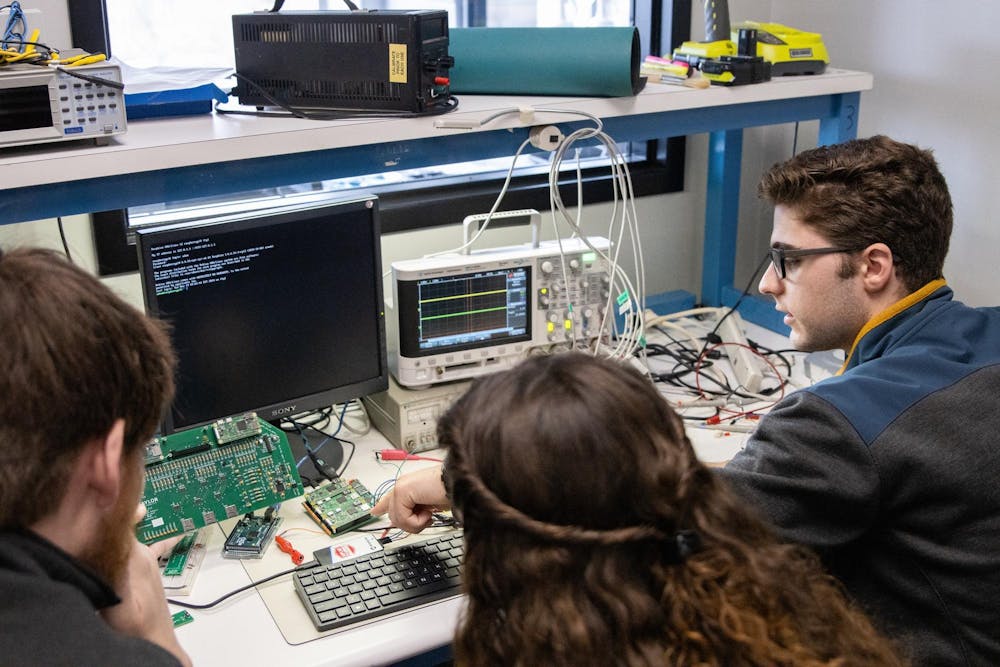
Dream Big phase one launched a six-satellite constellation from Vandenberg University, Calif. on March 30. Students from Taylor University, Purdue University, University of Notre Dame, University of Toledo, Western Michigan University, Valparaiso University and Aiglon College (Switzerland) built these satellites, Dillon Embry, project manager at NearSpace, said.
The Don Wood and Avis Foundations funded the launch, providing such a generous donation that participating schools only paid for their satellite payloads, Alex Reno, director of entrepreneurial programming and operations, said.
“They were very happy to come on and very graciously supported us in this,” he said.
At Taylor, the launch contributed to SkyForge, the university’s senior engineering capstone project, Peter Staritz, associate professor of physics and engineering, said.
It was fulfilling to watch students’ hard work come to fruition, Embry said. He watched the project push students toward cross-disciplinary work, character development and love for learning, he said.
“It’s really exciting and rewarding when you get to see the students and their excitement around the project,” Embry said.
After celebrating phase one, NearSpace announced phase two.
This NASA-funded initiative recruits middle schoolers to build micro:bits, pieces of computer hardware that can measure data from their environment, such as temperature, pressure or steam. The micro:bits will attach to and launch from a satellite.
“We will be having 900 students throughout the state of Indiana – middle school students – programming micro:bits,” Reno said.
NearSpace will enlist 30 groups throughout Indiana to build one micro:bit each. The groups will be split into six regions that contain five schools each.
Schools decide what data sensors their micro:bits have.
“We're not trying to give them too many parameters that they have to work with in their sensor choices,” Reno said. “Because it's always exciting to see what the kids can come up with and what they think would be fun to learn about.”
Middle schoolers will be able to track and gather data from their bits when the satellite containing the hardware launches around 2028, Reno said.
This project focuses on a younger audience than its predecessor did, Embry said.
Reno shifted toward middle schoolers after realizing how formative this time is in student’s lives, Embry said.
That’s why NearSpace strives to instill in kids a sense of wonder at the world and how it works at a young age, Matthew Voss, NearSpace Launch president, said. Hobbies cemented in middle school, such as an interest in space engineering, are explored in high school as students consider career aspirations.
It’s important these young explorers learn alongside those with differing backgrounds and ages, he said.
“We’re trying to cross-pollinate a lot of different ecosystems together,” Voss said. “That’s where innovations happen.”
Space is the perfect atmosphere for unified exploration: it’s a place of wonder, curiosity and learning, he said.
That’s why NearSpace hopes to make space accessible to people of all ages.
It’s mind-blowing that kids today are able to explore space, Reno said.
“When I was in middle school, to date myself a little bit, we didn't have bits. We didn't have cell phones,” he said. “And at this point, these middle schoolers will be able to pull out their cell phone or get on their tablet and pull up our portal and say, ‘Cool, there's my satellite going over Asia right now. And here's the live data I'm getting back from it.’”
Reno wonders what accomplishments middle schoolers will achieve by the time they reach high school, college or even adulthood if they’re already sending things into space at such an early age.
As someone who’s been alive for three quarters of a century, it’s fulfilling to inspire students with a passion for learning about the world and finding their place in it, Hank Voss, president and founder of NSL, said.
NearSpace teaches students to stay passionate about their work and curious about the world, which can positively impact the trajectory of their lives, he said.
“They don’t just read about space,” he said. “They explore. They send something there.”


