
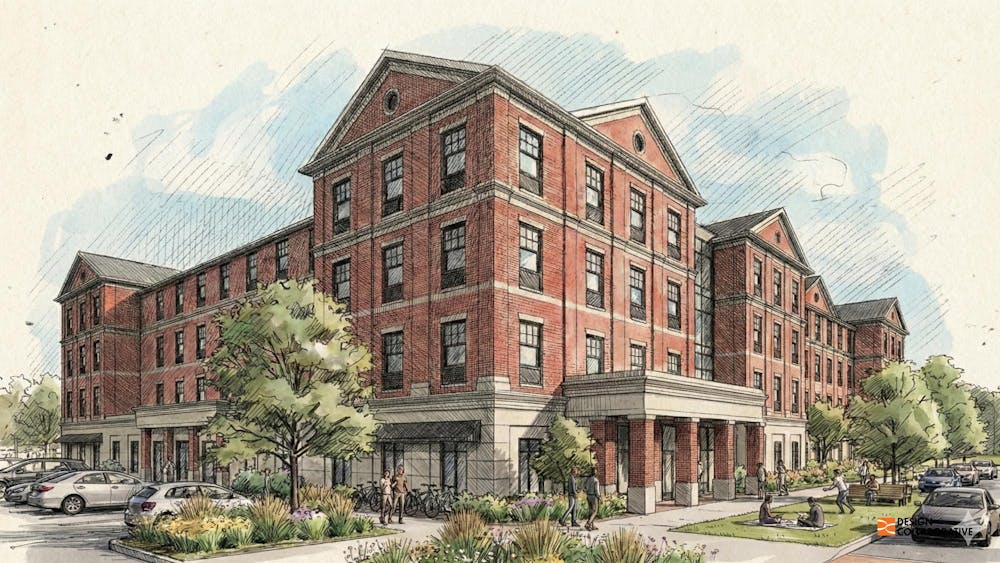
Before students arrive to inhabit it, Paul and Barbara Gentile Hall will be a shell of itself. Literally.
To construct Taylor’s newest dormitory, Taylor is using precast elements with cast-in-brick construction, Keith Cocking, senior director of construction services at Taylor University, said. Though a popular construction technique, precast construction is unique among the other buildings on Taylor’s campus.
With this method, sections or “panels” of Gentile Hall’s exterior walls are built off-site at a factory that specializes in this type of construction, Cocking explained. These panels will then be brought to Taylor and connected on-site, creating a giant exterior “shell” that will be transformed into a dormitory throughout the late spring and summer months.
“Instead of building walls out of metal studs and then applying cladding to that, and then applying brick by hand to that, a factory is actually taking giant molds in big sections and pouring concrete into them, putting insulation in the middle, and then hand laying bricks and then pouring concrete,” Cocking said.
To create these panels, Taylor is working with Fabcon, a company that specializes in precast construction located out of Grandville, Michigan, Cocking said.
After the wall “cures” or dries, Fabcon workers extract it from the mold, and a full section of Gentile Hall — from interior to exterior — is completed.
Gentile Hall will be made up of approximately 930 panels, Cocking said. Since each panel functions as a unique piece in a very large puzzle, Fabcon has created a master plan showing how each section fits together and labeled each panel accordingly.
Fabcon also makes the panels in a strategic order, creating them and releasing them in order for when they will be needed for construction, Cocking said. Once the construction site is prepared with a fully-built crane, these panels will be laid horizontally on a flatbed truck and driven to Taylor.
Though the date is still being adjusted, the crane will be constructed in early April, a process that usually takes about a week. Once the crane is finished, the first set of panels will arrive.
At the construction site, workers will use the crane to maneuver the panels into an upright position. From there, Cocking explained that workers will connect the panels, forming the dorm’s exterior walls.
The method of sealing the panels depends on the size, location and type of panel. However, for many of the sections, the precast manufacturer is inserting structural steel into the “seam” of the panel, the side where panels will connect, Cocking said.
Once the panels are ready to be joined, workers will weld or bolt the steel together and then coat the connection with a waterproof sealant on the interior and exterior.
After connecting and sealing the panels together for the first floor, workers will brace Gentile’s newly-constructed walls and lay more panels horizontally on top of the first floor, simultaneously creating the ceiling for the first story and the floor for the second story. Then, the process repeats.
“(The workers) will just continue trucking panels here and assembling them and working their way up,” Cocking said. “So they'll start on the west half of the building and continue around to the east half.”
The university considered a variety of construction methods, including wood-based and hybrid steel structure buildings, Cocking explained. However, the school settled on precast because of its speed, labor reduction and durability.
By using the precast method, the west half of Gentile Hall – the portion facing Third Street and the Campbell apartments – will be ready to house 117 students by the fall of 2026, a year ahead of schedule.
“We're basically able to stand up half of the building in roughly a month, something that would normally take six months,” Cocking said.
Immediately after the shell of the west half is completed in May, workers will begin finishing the interior, fitting the dorm with plumbing, electrical, and mechanical work. Though the east half will be standing by June, the interior will not be student ready until the winter of 2026.
This method’s speed comes from the factory’s ability to streamline the construction process. With a set plan for each panel and immediate access to all of the necessary materials, the factory can create a finished wall in fewer steps.
However, precast construction requires extreme forethought, precision and organization on the part of the university, Cocking explained.
“(Precast construction) requires an extensive amount of coordination, because all of that has to be done exactly right,” Cocking said. “Because when it shows up on site as a big Lego, if it's wrong, you're in pretty big trouble. So it's just a shift in saying the complexity of the building is actually happening ahead of the game, off-site somewhere.”
Cocking highlighted the administration’s intentionality in planning Gentile Hall. When working with Design Collaborative, the architecture firm for this project, the university laid out multiple non-negotiable features, such as floor lounges, communal bathrooms and central stairwells, to ensure Gentile reflected a traditional Taylor residence hall.
“We wanted it to be something that is here for a very, very, very long time,” Cocking said. “I think everybody wants that when you think about a dorm identity, and I think it strengthens all the feelings around dorm culture.”
While Gentile Hall is being constructed, the dorm’s future personnel assistants (PAs) and discipleship assistants (DAs) are also working to build a new dorm culture.
Nathaniel Berry, a sophomore politics and public service major, will serve as PA for the fourth floor of Gentile, the dorm’s only male floor. Together, the leaders decided the fourth floor will be called Homestead.
“We're going to be the homies of Homestead,” Berry said.
On Homestead, Berry hopes to create an environment of both encouragement and accountability, something he feels Taylor can sometimes lack.
Floor leadership also hopes to create a place where students can be themselves, Ethan Schmidt, a sophomore youth ministries major and the DA for Homestead, added.
“We're aiming for a general authenticity,” Schmidt said. “ ... Somewhere where the guys can be real about their faith, be honest and spur each other on openly and lovingly and be able to simultaneously feel accepted and seen.”
Schmidt acknowledged the large task at hand, labeling his new position as both humbling and terrifying. However, he and the other student leaders are clinging to the reminder that this project isn’t theirs to begin with.
“This is so far beyond anything that we could all handle on our own, and so we're all able to approach it with the heart that this is not our project,” Schmidt said. “We're joining God in his work that he's already beginning to do. The change that's going to happen in those guys — God's already working in their hearts to make that come to fruition. We're just going to come alongside him as he does that.”
Ultimately, Homestead will be a group project, Berry said.
Though the DAs and PAs can provide structure, the residents play a big role in the direction of a wing or floor.
“We can bring structure, and we can be good stewards of the resources given to us by providing a structure, but the substance is only going to come when everybody moves in,” Berry said. “ … The culture is less something that the PA and DA team creates, but more so something that they help cultivate,” Berry said.
Both Berry and Schmidt indicated that traditions and events were in the works for Homestead’s homies. However, when asked for specifics, Schmidt remained mysterious.
“That's for us to know and for you all to find out,” he said.

