
The Invitation Clinic, sponsored by Taylor University, has a dual purpose: training students to be caring, effective health educators and serving Grant County residents. Entirely staffed by Taylor students from a variety of majors, the program teaches patients lifestyle medicine principles to avoid or manage chronic disease.
The clinic’s vision of inviting patients into a fuller life inspired the program’s full name: The Invitation Clinic — ‘INspiring VITality And Transformation In Our Neighborhoods.’
The clinic meets a pressing need in Grant County. Out of Indiana’s 92 counties, Grant County ranked 91 for health outcomes, Indiana’s 2020 County Health Rankings Report, a measurement of the population’s length of life and quality of life, stated. The county also has some of Indiana’s highest rates of obesity, diabetes and pre-diabetes, Hayes, professor of kinesiology and one of the clinic’s co-founders, said.
The clinic was originally designed as a prevention program for Type 2 diabetes. However, it has expanded its focus, since several chronic illnesses can be prevented or managed by making lifestyle changes, Scott Fenstermacher, assistant professor of kinesiology at Taylor, said.
The vision for a student-run clinic stemmed from Hayes’ educational background, Hayes said. He worked under an athletic trainer for 1500 hours while taking classes, something he called an “invaluable” experience and wanted to recreate for Taylor students.
Hayes and Diane Dungan, associate professor of psychology at Taylor and one of the program’s supervisors, envisioned a program that would serve the community while also educating students interested in entering the medical field.
“We wanted to train students differently to be health practitioners who could incorporate lifestyle medicine into whatever career path they chose,” Dungan said, “whether that be psychology or medical school or dental school.”
Before working at Invitation, students take a one-semester course called Health Education for Behavior Change. Taught by the three supervisors of the clinic — Dungan, Fenstermacher and Bradley Kendall, associate professor of kinesiology — the course covers the information students require to work with the patients at the clinic.
After completing the course, students are designated as health educators and are qualified to take patients one-on-one, reaching out to their supervisors when they need assistance.
Within each semester, 35 to 40 students work in the clinic, Fenstermacher said.
Some students only come into the clinic for a few semesters. Others see patients at Invitation for multiple years, Fenstermacher said. During their time at the clinic, the student health educators usually work two to four hours each week, depending on their schedule.
Because the clinic’s treatment plans and curriculum are tailored to each patient, health educators learn how to adapt and think on their feet, Dungan said.
Patients are either referred to the clinic by their medical provider or come on their own, hoping to achieve personal health goals, Dungan said. The first appointment, the “intake session,” is free. Each follow-up session costs five dollars. However, no patient will be turned away if they cannot pay, Fenstermacher said.
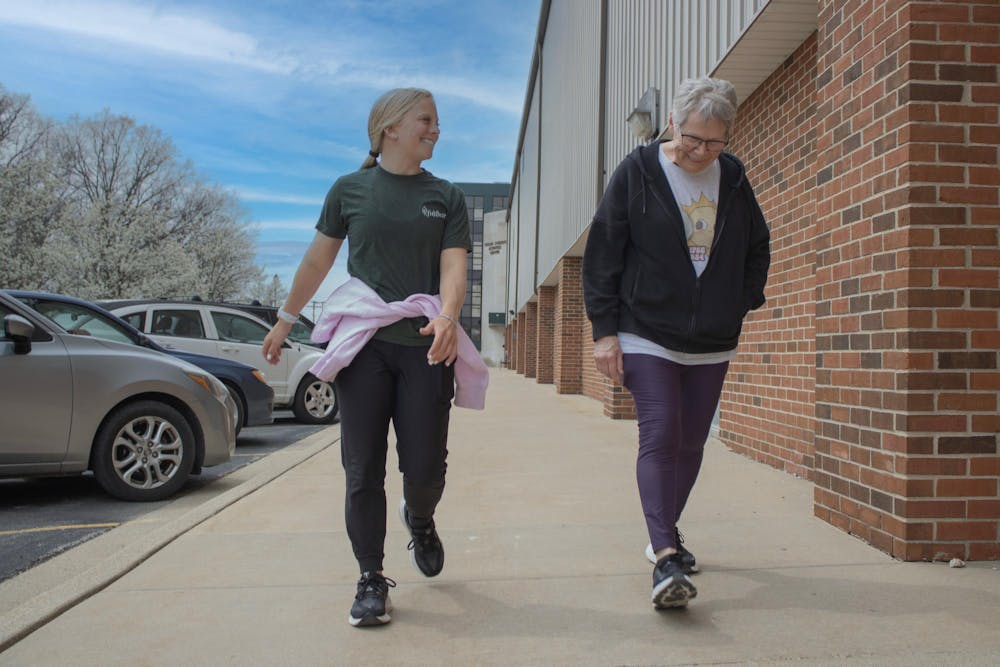
After clients review the program and fill out health information and goals, they are matched with a student health educator to help them achieve their fitness goals. Most patients work with their educator twice a week for about 45 minutes.
Though originally designed as a year-long program, the clinic’s highly individualized program results in varied patient retention, Kendall, one of Invitation’s supervisors, explained. Client attendance could range from five months to multiple years.
“Progress looks really different for people,” Dungan said. “You know, we always think of the individual coming to a program who can do it all, but sometimes … doing well in a program means you maintain or make slight, small gains.”
Austin Layton, a 2023 Taylor graduate and medical student at Marian University Wood College of Osteopathic Medicine, worked in the Invitation Clinic during his time at Taylor.
Though initially nerve-wracking, working with individuals at Invitation taught him how to listen well and meet people where they were at, Layton said.
His experience at Invitation made him and his fellow health educators “absurdly prepared, comfortable and confident” when working with patients in medical school, he said.
“Our knowledge and what we learn is important, but sitting with patients and being able to connect with them and have them trust you is the biggest part,” Layton said. “Because if I give advice to someone but they don't trust me, that advice is no good.”
Working in the Invitation Clinic also taught him foundational lifestyle and preventive medicine principles, such as exercise and nutrition, which many medical schools brush past in their course content, Layton said.
When creating the clinic, Hayes and Dungan wanted to build a program that not only trained students and healed the community but also helped share the gospel.
Christianity is an embodied faith, Hayes explained. God cares about whole-person health and invites people into a life of abundance. This invitation includes physical as well as spiritual wellness.
Dungan echoed Hayes. Viewing health through the lens of Christ is powerful, she said.
“We see Invitation as a living out of the gospel — that the gospel is not just a list of do’s and do not’s,” Dungan said. “The gospel is really an invitation to abundant life, to better living. And we wanted to provide an invitation to people in the community to live a different life.”

