
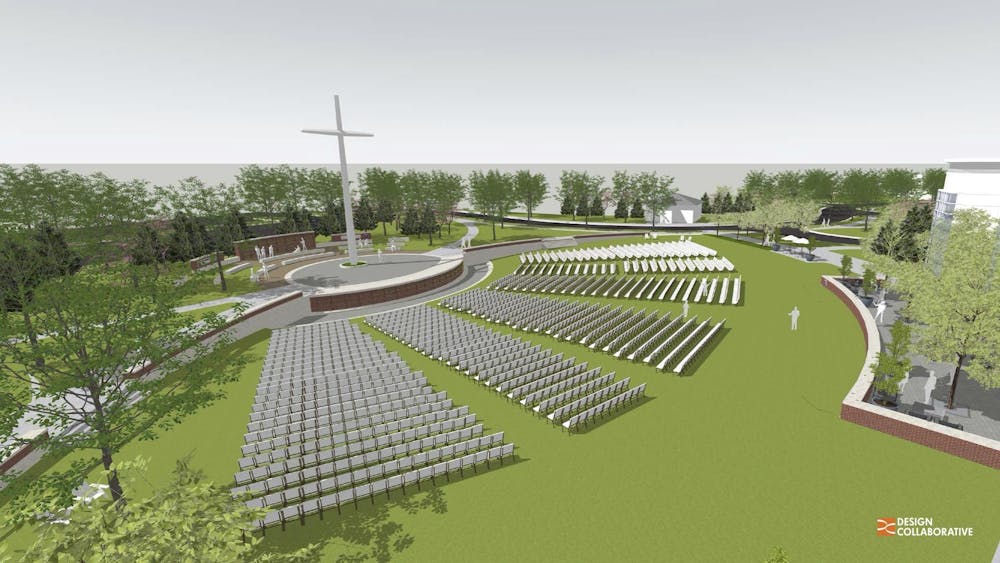
During the Chapel service on Jan. 26, President D. Michael Lindsay announced the construction of a new Taylor landmark: a 50-foot high cross and surrounding amphitheater, funded by a $10 million donation. Yet some students are questioning whether a cross is truly what Taylor needs.
The Rev. Greg Dyson, vice president for spiritual life at Taylor, is one of the proponents of the cross project. He described the cross as something he hopes will fulfill actual needs on campus.
Emphasizing the symbolism of the cross, Dyson said he hopes the cross will provide an “anchor” for the stage in front of it.
“Here is something being put in place that speaks to our faith,” Dyson said. “If there is no cross — I don’t mean the physical cross, I mean the work of the cross — then our Christianity has nothing to stand on. Our faith has nothing to stand on. The work that we’re trying to do, the faith, love and truth that we’re trying to emulate and go out with has nothing to stand on if Jesus didn’t die and rise again. This whole idea is following that.”
Dyson said the cross location will be a multi-use area. Though the new chapel will be the largest seating area on campus, the amphitheater will offer a place for worship groups to perform outdoors. He said it should save money in the end, rather than using spaces such as the lawn between Euler and Reade for concerts it was not made for.
The amphitheater will also help attract artists, Dyson said. In the past, artists have declined to perform at Taylor due to the small size of Rediger Chapel.
The outside venue will have 500 more seats than the current chapel.
The donors’ names have not been released, but Dyson said they will most likely become public. He hopes the project will not be about the amount donated but rather make generosity contagious.
The cross, reaching at least 50 feet, would come close to the height of the Rice Bell Tower, a symbol of Taylor, which stands at 72 feet, according to previous reporting by the Echo. The Bell Tower too is filled with Christian symbolism: a cross is laid out in brick at the base of the tower. More notably, the two brick pillars symbolize faith and learning, testifying to Taylor’s mission to connect the two often disparate spheres.
“When you think about the skyline of our campus, you always see the spires,” Dyson said. “Now, they haven’t always been there, but once they got built, this idea of faith and learning together (followed), and all these things that are written in the stone around it. That’s a beautiful picture right there. I think the cross is following that same kind of thought, but actually larger.”
A few students, however, have questioned whether the cross is the best use of Taylor’s funds. Mason Dean, the discipleship assistant on First Bergwall, is one skeptic.
“I think that it will be a really cool image that will remind us of Christ’s sacrifice,” Dean said. “However, I think that’s a waste of money. The money could be spent in better ways, like to better the campus or just given to students — going to Taylor is expensive.”
Dean said the gym needed renovation and expansion, along with many other areas around campus.
In response to such concerns, Dyson emphasized the fact that the cross was being built solely with donor money, which must follow the wishes of the donor and cannot be diverted elsewhere.
Moreover, Dean felt there was a lack of need for the cross, as students already had a number of places to pray and worship.
“We already have the memorial prayer chapel, we have the other prayer chapel on the other side of campus, and you can always pray in your room,” he said. “I, for one, would not want to pray in a public space like that.”
Dean said he believed the majority of the student body preferred more private expressions of spirituality than the cross and amphitheater would provide.
Other students aren’t aware of many of the project’s details. Alie Lewis, a senior English education major, said she hadn’t heard much about the cross.
“All I know is that it’s going to be really, really big,” Lewis said.
Lewis said she didn’t have a strong opinion, a fact she attributed to her status as a senior, and that many of the new building projects won’t impact her as a student.
Nonetheless, Lewis wondered how much the cross and amphitheater would cost, and whether the money could be going somewhere else.
“I’m probably biased as a student who pays so much tuition money,” Lewis said, “but it feels like we don’t need an amphitheater. Maybe we could use some more scholarship money.”
That sentiment was echoed by Jackie Hicks, a junior film major.
“I feel like there are more pressing needs, like, you know, AC in dorms.” Hicks said. “And especially as someone with a disability, improving campus accessibility.”
Hicks emphasized the lack of accessible accommodation in residence halls, which has limited her living options.
Hicks, a former DA, said she understood the desire to have a space dedicated to worship. She felt, however, that Taylor did a great job with outdoor worship without the amphitheater. The project, she felt, was aimed at donors and prospective students, not current students.
Nonetheless, she hoped the project would enrich Taylor’s campus.
“It feels a little bit unnecessary to me,” Hicks said, “but I also understand the metaphor of living in the shadow of Christ. And I don’t actually know what it’s going to look like, so it might look really nice.”
Student opinion will no doubt solidify once more information is released. Until then, whatever feelings students express, Dyson welcomes them.
“Students have just come to this place of asking the questions, listening carefully, and giving input,” Dyson said. “And, actually, that input helped determine the location for the cross. And the dialogue’s been healthy and it's been inspired and encouraged by students.”


