
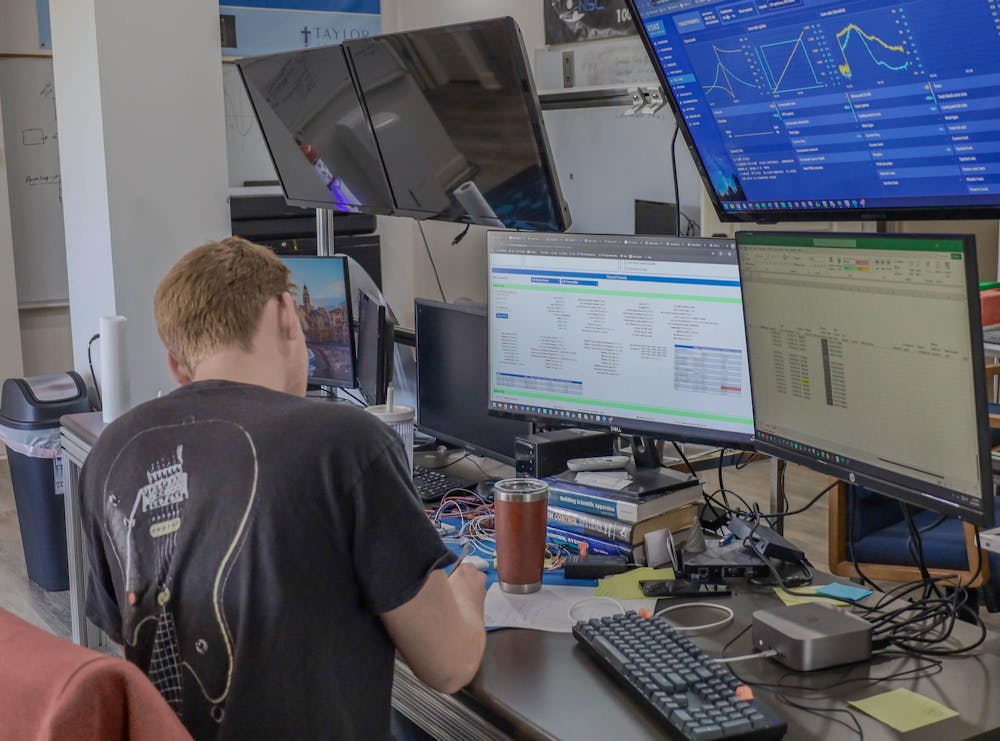
Taylor’s engineering department launched a satellite payload into space late March from Vandenberg Space Force Base, Calif. The launch was part of SkyForge, the university’s engineering capstone project, Peter Staritz, associate professor of physics and engineering, said.
Staritz leads SkyForge. He works alongside Dave Peter, assistant professor of physics and engineering and Alex Roth, assistant professor of engineering.
NearSpace Education, a nonprofit that funds engineering initiatives, supports SkyForge through their Dream Big initiative
SkyForge has evolved over time. Initially, sending objects into space seemed unattainable, Starritz said. As the team built confidence and knowledge, they worked on robots to send to space. One day, they hope to assemble a structure in space using these robots, he said.
“We are making robots that would walk on that structure and put the pieces together,” Staritz said. “So as stuff comes up (to space), a robot takes it off the rocket and walks it to where it belongs, and then sort of unpacks it and puts it together. Sort of like Legos.”
There are many subsets within SkyForge, and they can get confusing, Roth said. But together, these parts will eventually converge as a complete SkyForge robot.
The main focus of SkyForge is these robots, not the satellite launching in March, Staritz said. A robot prototype will rocket into the cosmos around April 1, he said.
SkyForge CORE, the computer functioning as the robots’ brains, is the subset of SkyForge Taylor will launch on their NearSpace satellite, Roth said.
“The CORE will be verifying that our design allows the computer to function in space where radiation from the sun normally ruins computers,” he said. “It will simply be doing some calculations and if we get correct results without errors, we will know that the computer is functioning as expected.”
SkyForge CORE blasted off alongside other satellite experiments from schools including Notre Dame, University of Toledo, Valparaiso University, Western Michigan University and Purdue University Fort Wayne. These launches each test how different technologies function in space, Roth said.
Taylor’s pre-made satellite is provided by NearSpace.
“Having NearSpace Launch as this close companion is really helpful,” Staritz said. “Because from a cost standpoint, putting things in orbit is really expensive.”
NearSpace provides support and funding, he said. However, the payload, CORE computer and robots are built by Taylor students.
Staritz is excited yet nervous for the launch.
“Launches can slip,” he said. “So we’re just waiting to see (what happens).”
Space is unpredictable and challenging: the satellite could function incorrectly once launched due to poor weather conditions, improperly functioning equipment or for no reason at all, he said. The satellite could de-tumble incorrectly, endlessly tumbling in orbit and leaving the SkyForge team unable to communicate with it.
Staritz is proud, no matter the results of the launch: his students poured their hearts into the project. They did everything in their power for the technology to succeed. Did they enjoy the project all of the time? Definitely not, he said. But digging deep into their field through late nights and hard work was beautiful.
“I don't think I can overestimate or overemphasize that they just worked so hard,” Starritz said. “Because, in truth, when you're doing something here on Earth, if it breaks, it's not that big of a deal. You just reload your code and try again. If it's in space, you're done, right? There's nothing you can do.”
It’s game over if the machines don’t function correctly in space. Because of this, students meticulously check their work for errors while fitting quick deadlines.
Students struggled on their own, Starritz said. They’d advanced so far in their specialized fields that no one, not even their professors, could help them. It wasn’t like homework; Staritz would have to learn the material before he could explain it to them, he said.
This pushes students to excel in ways they couldn’t if they were dependent on their professors to learn, he said.
“They've gone deep enough that they've exceeded my knowledge,” Staritz said. “Which is a great place to be, right? That means that they're doing something that the world actually cares about.”
Projects like SkyForge will push Taylor’s engineering students to change the world. This enables them to represent Christ amidst their secular field, he said.
This is especially important in American culture, which is beginning to drift away from the Lord, Starritz said.
“As they go out, they'll encounter lots and lots of people that they can engage with and love and share the gospel with and have a true impact on our culture and this nation,” he said.
Christian engineers have a unique chance to point coworkers to Christ through the very nature of their field, Kate Keeler, senior mechanical engineering major, said. Keeler has worked on SkyForge for the past 2 school years.
The sciences explore details of creation that point to God, so spending time in creation can open people’s eyes to His beauty and provide evangelism opportunities, she said.
“Even if they don't know it, they're learning more about God and about his character and getting windows into him and his and who he is,” she said. “And that might lead to faith.”
While she may not enter the mission field, Keeler can witness to others in this way, she said.
That’s why it’s important to have Christians with strong faith, ethics and willingness to share their faith in science fields, she said.
“Every work field’s gonna need it,” she said, “Especially the science based ones, because there's not a lot of Christians inside science fields.”


