
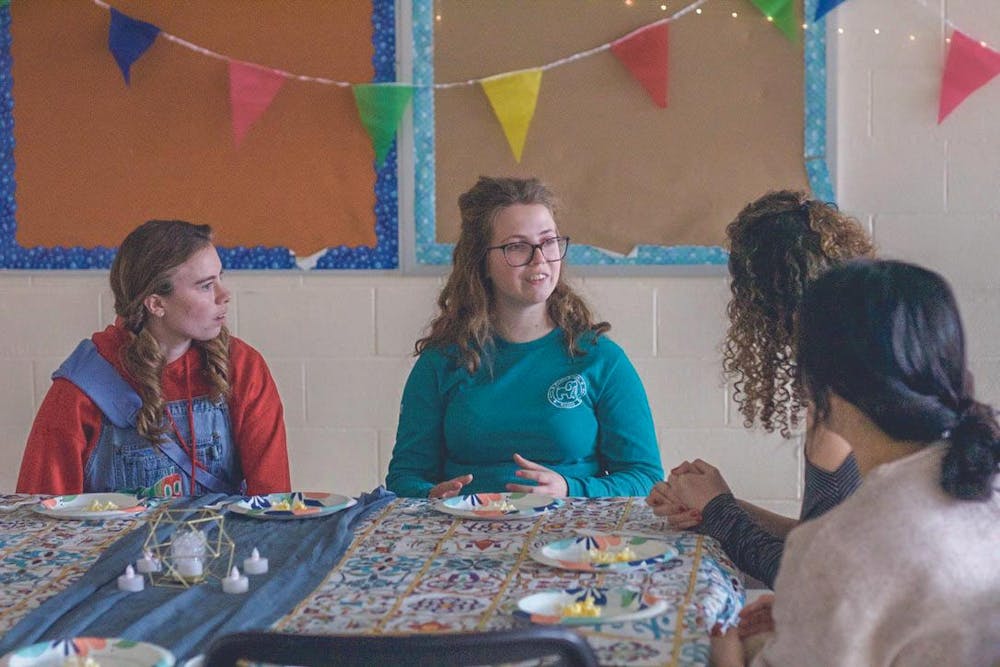
Guests who attend Boxes and Walls in the Reade Liberal Arts Center each year get the opportunity to experience a series of simulations mimicking intercultural experiences and situations.
The goal is to help people step into others’ shoes in order to learn open-mindedness and empathy, Silvia Palax Cojtín, a senior business management major and co-president of the Multicultural Student Association, said.
“It’s kind of like an OIP open house,” Kate Franklin, a freshman music education major and MuKappa member, said. “It kind of is an opportunity to get to learn more about your peers on campus and to be able to learn how to ask different questions, and to get to know a different part of the students around you that you might not otherwise be able to understand.”
Boxes and Walls is organized by MSA, and visitors are guided through a series of seven simulation rooms hosted by various organizations within the Office of Intercultural Programs.
Each room focuses on a different challenge faced by members of the host group, teaching people how to open up about their experiences and engage with what others share, Cojtín said.
“I don’t know about you that much, you don’t know me that much, you don’t know the different events and experiences that I have had that have shaped me, and I don’t know anything about you, too,” she said, “So I think Boxes and Walls is a place where we collect different ideas, different situations, and experience them.”
MuKappa hosted a room focused on experiences related to living among different cultures.
MuKappa is an organization built around third-culture and missionary kids. In other words, people who were raised in cultures or countries different from their own or their parents’ nationalities.
To represent and teach this concept, MuKappa members set up a simulation involving three plants representing members of the organization and a variety of containers representing different cultures. Visitors explored these members’ stories as they set out to identify the most appropriate pot for each plant, Franklin said.
“Some of the containers didn’t fit as well as others,” she said. “Maybe they were too big or too small, and that was really symbolistic of how, as an MK or a TCK moving to different countries, some places fit better than others, but at the end of the day the people that you’re surrounded by are your home.”
Learning opportunities like Boxes and Walls help people form deeper understandings of what other people have gone through that has shaped them, Cojtín said. Developing this understanding helps people approach new situations with openness and curiosity, she said.
Another important component is learning how to ask questions that facilitate meaningful connections with peers, Franklin said.
“Something that I've been thinking about a lot is the idea of curiosity being a love language,” she said. “I think events like this really give you an opportunity to understand the different sides of people that you maybe wouldn’t otherwise get to know, and then through that you can be able to learn how to ask questions.”
It can be challenging to gain awareness of others’ experiences, let alone relate to them, so events like Boxes and Walls are important because they make stepping into others’ shoes more accessible, Franklin said.
Boxes and Walls is a bridge for finding mutual understanding, and it attempts to reflect the message of Revelation 7:9, Cojtín said.
Despite differences in appearance and stories crafted by God, all tribes, nations and tongues are ultimately united under Him, she said.


