
Salaam, Arabic for peace, was brought to the Euler Atrium in more ways than one.
On April 17, the Middle East Collegiate Association hosted Salaam: Music from the Near East, a night of conversation, refreshments and music.
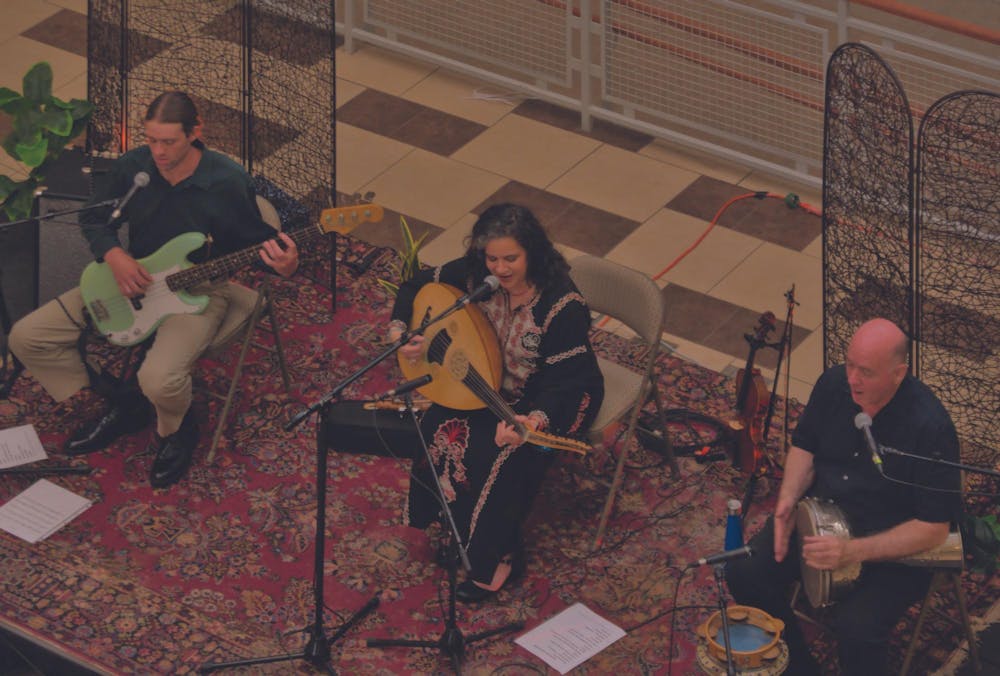
The night focused on Middle Eastern music. MECA brought in Salaam, an Indianapolis-based Middle Eastern band, to perform traditional music with modern flair.
The band performed songs from various cultures, including Lebanese, Egyptian, Tunisian, Iranian, Persian, Syrian, Iraqi and Palestinian.
“One thing that, as a club, we’ve been trying to maybe teach Taylor more is just the variety of different Middle Eastern cultures,” Daron Nouri, a junior biochemistry major and MECA member, said. “The Middle East is just so vast that just this one band isn’t going to explore all of the aspects of the Middle East per se, but maybe just encourage people to be more interested in digging deeper into that on their own time.”
The event was intended to be both musical and educational, helping to break down stereotypes about the Middle East and cast it in a different light, Addie Becker, a freshman marketing and management major and MECA member, said.
The educational nature of the night was largely facilitated by Dena El Saffar, a member of Salaam. Between songs she shared snippets of history about the songs, the instruments and the band itself.
The band chose to go by the name Salaam because it means peace, and that is both their vision for the world and what they hope to bring through their music, Saffar said.
“This isn’t necessarily music that I grew up with, and yet it felt nostalgic and personal,” Hadleigh Brown, a junior history major and MECA co-president, said. “It was so beautiful and, honestly, just so peaceful. It was just so filled with salaam.”
Alongside the origins of the band’s name, Saffar shared about the evolution of instruments used in Middle Eastern music, such as the joza and the ‘oud. She played both distinct stringed instruments during the concert.
Middle Eastern music is also characterized by its openness to incorporating newer instruments, she said, pointing out her fellow band member Jamil Moore’s electric bass guitar. As long as an instrument can “fit in well,” it can be used in Middle Eastern music, she said.
Middle Eastern music is unconcerned with staying “within the box,” as evidenced by the fact that Salaam performs without sheet music, sometimes making in-the-moment modifications, Saffar said.
Each of the three band members swapped between instruments, and each combination of instruments provided a unique sound.
“Despite there only being three instruments at a time, each one is played creating so many layers that it completely fills up the space,” Elise Coleman, a sophomore creative writing major and audience member, said.
The music “fills your ears,” Brown said.
This concert and its high attendance matter because they demonstrate that Taylor sees the beauty of the Middle East, she said.
“Most people here already had a heart for the Middle East, and I think it grew a couple sizes,” Brown said.
Besides their yearly big events like this concert, MECA regularly hosts mint tea, an opportunity for students to engage in intentional community and learning, among other events. During mint tea the Office of Intercultural Programs develops a cozy atmosphere and MECA offers open conversations, presentations, games, refreshments, music and, of course, tea.
MECA helps students engage with cultures by offering different perspectives and unique outlets to learn through, Becker said. People are able to stay informed on upcoming events by following the TU MECA Instagram page.


