
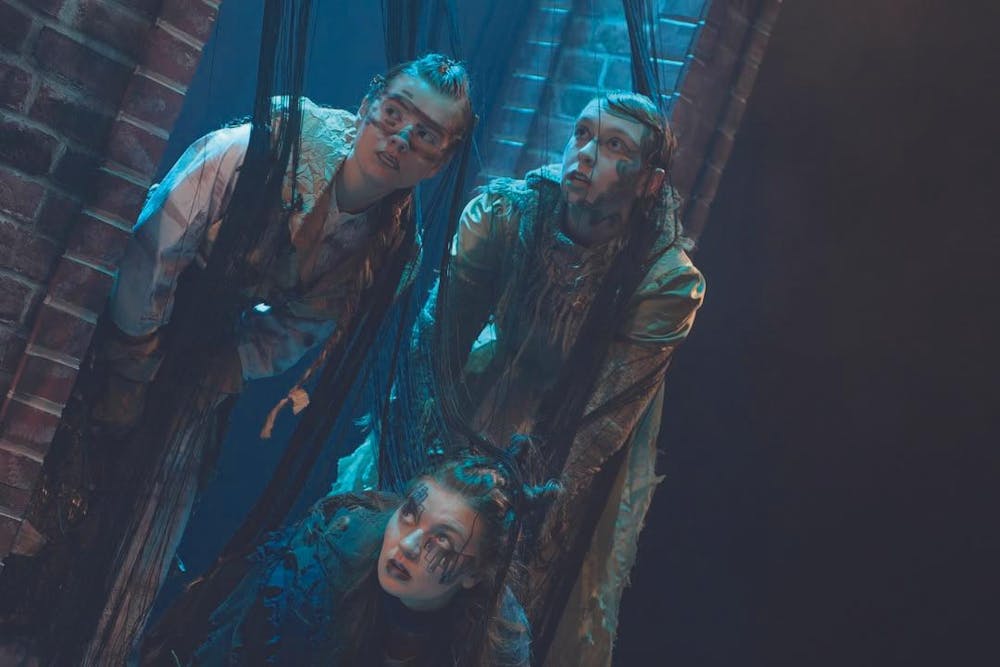
Dripping water echoed around the confines of Mitchell Theatre as Taylor University’s production of “Eurydice” invited audience members into a world that suspended memory and belief.
Written by Sarah Ruhl as a reimagining of the classic Greek Orpheus and Eurydice myth, the play follows Eurydice’s journey through the underworld, exploring themes of decay, identity and family.
The play speaks to many themes that go beyond the typical myth, Tracy Manning, assistant professor of theatre arts and managing and artistic director of theatre, said. Through its abstract storytelling and powerful symbolism, the play invokes questions of loss and meaning, she said.
“In the play, when characters lose their memories, they slowly lose themselves,” Manning said. “Memory isn’t just recollection; it’s identity, it’s selfhood.”
The entire production was framed around this idea of decay, Manning said. It was infused into both acting rehearsals and the design of the show, from the set to the lights and costuming.
The water elements used throughout the show are deeply connected to this, adding visual and symbolic elements to the production, she said. The use of water expanded on the ideas of identity and ideology.
“Water becomes a metaphor for forgetting and for oblivion and for emotional numbness,” she said. “It’s both soothing and terrifying; it promises peace, but at the cost of identity.”
Onstage, water was an integral production aspect. It rained in the elevator, pooled into the grates, and sparkled under the lights. These touches made it necessary for the set to be highly waterproof.
The set was designed to be reminiscent of an old train station, a place of the in-between, where one just passes through, Cameron Damesworth, a junior musical theatre major, master carpenter and shop crew supervisor, said. The worn brick signaled decay, but dirtied floor tiles gave a nod to former beauty, he said. This blur between the old and the beautiful, the real and the imaginary, and the underworld and overworld is conveyed through this design.
“The underworld isn’t a hard and fast boundary; it’s just right there, as if hidden by a veil that we can’t see — like looking through a window,” he said.
The installation of the raked stage, or the floor’s angling up and away from the audience, proved to be one of the biggest challenges Damesworth faced. Due to other production demands, such as the installation of lights, the raking was installed last minute, just before the last dress rehearsal.
However, all the hassle was worth it. The set pieces created a cohesive world that audiences stepped into.
Lighting played an integral part in separating the overworld and underworld as well, TJ Fausnight, a junior musical theatre major and master electrician, said. The lighting design bisected the stage, with both lights and shadows providing emphasis on certain moments or onstage locations.
One striking moment fueled by this lighting was when Orpheus stood just behind the strong curtain, Fausnight said. In the scene, Orpheus was bathed in strong, warm light — an encounter that signified hope, but only for a fleeting moment in time as the light sat upon his face, and then disappeared.
Fausnight’s characters, the Nasty, Interesting Man and the Lord of the Underworld, embodied the duality of the production. Watching both of these roles forced the audience to sit in discomfort as tension lingered from his interactions with Eurydice.
Amidst these themes and design pieces, “Eurydice” examines the intricacies of a father-daughter relationship that isn’t formed out of an epic triumph, but a reunion following loss. This portrayal of grief and reconnection resonates deeply, providing a mirror for audiences to see these themes in their own lives.
Manning noted that, after seeing this production, many students called parents and family members, reminded by the performance how quickly familial love can be taken away.


