
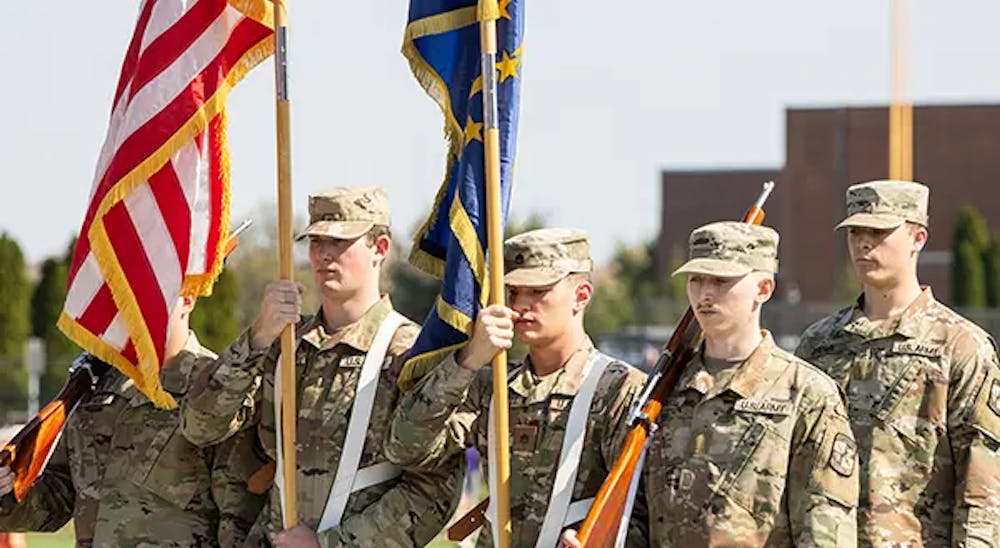
Two months ago, if students asked Scott Oleson, academic adviser at Taylor University and leader of Taylor’s Reserve Officers’ Training Corps (ROTC) program, about the trajectory of the program, he wouldn’t have expressed the optimism he feels today.
“I would have said that I am worried about the longevity of the program because of the state of the scholarship situation,” Oleson said. “Now I think it’s going to continue to blossom.”
In Fall 2024, the Army told a crushed Oleson they were eliminating scholarship funding.
February 2026, they announced the return of these funds, Oleson said.
The returning scholarships will increase future recruitment, Oleson said. Their removal wouldn’t have affected current cadets, but it would have disabled Oleson from offering scholarships to incoming freshmen, encouraging them to consider ROTC.
Now that the scholarships are back, Taylor’s ROTC brigade receives the most funding in their brigade (a unit within the ROTC program), since they’re the top performing company. Almost all Taylor cadets will now receive scholarships, Oleson said.
Because scholarships have returned, Oleson expects Fall 2025’s lull in recruitment to end. He’s already experiencing an influx of interested students, he said. He hopes to recruit at least 24 cadets for Taylor’s ROTC program in the future.
“Hopefully the full scholarships stay, you know, so we can continue to get new cadets into the program,” Oleson said. “Although, you never know with the Army or the government.”
Oleson expects to grow the program. Taylor faculty are working hard to develop the program, he said.
As of the 2025-26 school year, Taylor’s ROTC program added a minor in military science and leadership. Because the minor is under the Cornwall School of Business and leadership, Jody Hirschy, hodson dean of that school, academically oversees Taylor ROTC.
Oleson’s not exactly sure why the U.S. Army chose to reinstate scholarships, or why they removed them in the first place. Oleson suspects waning recruitment numbers motivated the return of scholarship funds, he said. This would drive a need for more officers, which ROTC programs produce.
If there’s a surplus of officers, it is fair and logical to cut funding, even if it is unfortunate for cadets, Joshua Talbott, junior mechanical engineering major at Taylor University, said.
When told the funding would be removed, Talbott understood, but he still expressed disappointment, he said.
“Part of the reason that I came here was to help … grow this program,” he said. “Part of the reason Taylor was attractive is that the ROTC program was really small, so it sounded, like, fun to be a part of starting something up.”
Many cadets felt similarly.
Ethan Schmidt, a sophomore youth ministry major enrolled in Taylor ROTC, was thrilled scholarships returned. Being told scholarships were jeopardized had been tragic, he said.
“There was almost, it felt, like no reason to keep continuing, because that was one of the biggest reasons that I had joined up in the first place,” Schmidt said. “And now to have it back, and to have two years at least 99% guaranteed to be free, is a huge blessing from God.”
Oleson is grateful he can continue to provide financial aid for his cadets through the returning funding.
He hopes to continue growing the program and providing more scholarships for Taylor students interested in enrolling on their ROTC brigade.
“I’m happy,” Oleson said. “I’m happy we got the scholarships back, and I’m happy for our cadets. They work hard and deserve the support and recognition.”


