
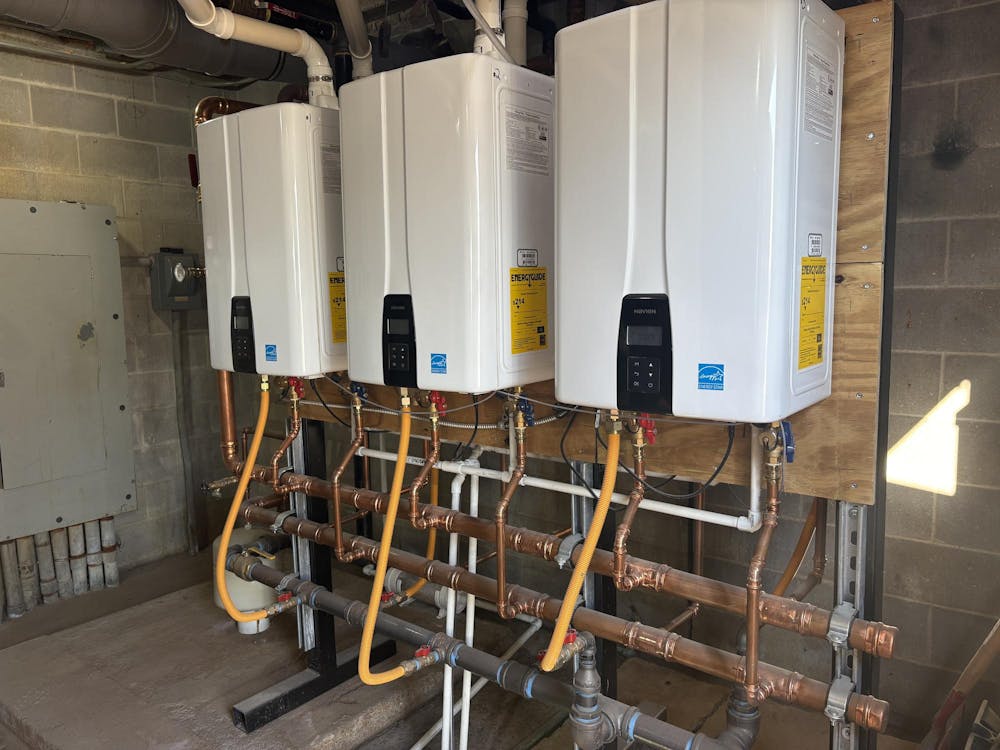
Taylor is saving energy, money and time by slowly replacing their traditional water heating system with a new innovation: tankless water heaters.
Eric Richards, lead tech for Taylor’s maintenance team, has started switching out the school’s traditional boiler systems with tankless water heaters. He invented and designed them, and he installs them when current boiler systems malfunction.
Richards’ appliances currently heat water in English Hall, Olson Hall and the Kesler Student Activities Center (KSAC). He’s installing four heaters in Gerig Hall soon. He hopes to do Breuninger Hall and Wengatz Hall next.
Richards isn’t going to replace current water heating systems unless they start malfunctioning. He plans to swap the tankless heaters out for traditional boiler systems as issues occur.
“There's not an end date,” he said. “It's just as things fail, then we have a plan to replace.”
The new tanks save large amounts of money, he said.
A typical boiler system is $25,000 per boiler and $14,900 for a 500 gallon tank of water. Richards designed, built and installed his whole system for only $14,200 at Olson.
The new water heaters also use a tenth of the energy a traditional boiler uses and run on natural gas. The separate boilers are grouped together and “talk to each other,” so when one runs out of energy the next boiler takes over. Together, they superheat water and instantaneously provide hot water to whoever needs it, Richards said.
They’re easier to install too. To start using them, Richards just rips out the old installations and slides the new ones into place, he said.
Richards hopes his invention makes life at Taylor better. He’s worked in maintenance for almost 16 years, almost two of which were at Taylor.
At Taylor, Richards first installed tankless water heaters in the KSAC six months after joining the university’s maintenance team. Two months later, he installed them in English Hall. Olson Hall soon followed.
Richards has created many innovations beautifying campus. He even built the mantles in Olson’s lobby using wood from his family farm. He loves working at Taylor, he said.
“This is by far the best place I’ve ever worked in my life,” Richards said.
Richards enjoys the dedicated, supportive maintenance team he works with and the grateful, joyful culture of the kids at Taylor. Taylor is the only place he’s ever worked where kids regularly stop him to thank him for his work instead of resenting him for not working quickly enough. His boss, Jeremy Taylor, encourages him to put his relationship with God above everything else, he said.
“I love him,” he said. “He is probably the best boss I’ve ever worked with.”
Stephen Olson, vice president for finance/CFO, appreciates Richards’ initiative to improve Taylor’s water system cost-effectively. Richards is a hard-working man determined to make the Taylor experience as wonderful as it can be, Olson said.
Richards is part of a team of people just as committed as he is, Olson said. Successes like the tankless water heating system reveal the hard-working team upkeeping Taylor’s grounds, he said.
“There's a real hard working group of people,” he said. “They're maintaining about 1.3 million square feet of building space in around 50 buildings.”
Often, students and faculty focus on the flaws of buildings they live or work in, Olson said. They forget how many other buildings and issues the maintenance team is responsible for. Taylor’s maintenance team is talented, hard-working, dedicated and self-sacrificing. They’re determined to support students whenever things go wrong, he said.
Since Richards joined Taylor’s maintenance team, he’s brought three or four brilliant innovations to the university, including the water heaters, Olson said.
Some people take the path of least resistance, though they could do something to improve the environment around them, Olson said. He respects that Richards sacrifices his time and energy to do what’s right and serve those around him.
“It's a really good example of somebody who is really competent in their craft and takes initiative to make a positive change,” he said. “He could do nothing. He didn't have to do that. He could have just kept maintaining the boilers that we have, but he saw a better way to do things and made it known, which is really commendable.”


